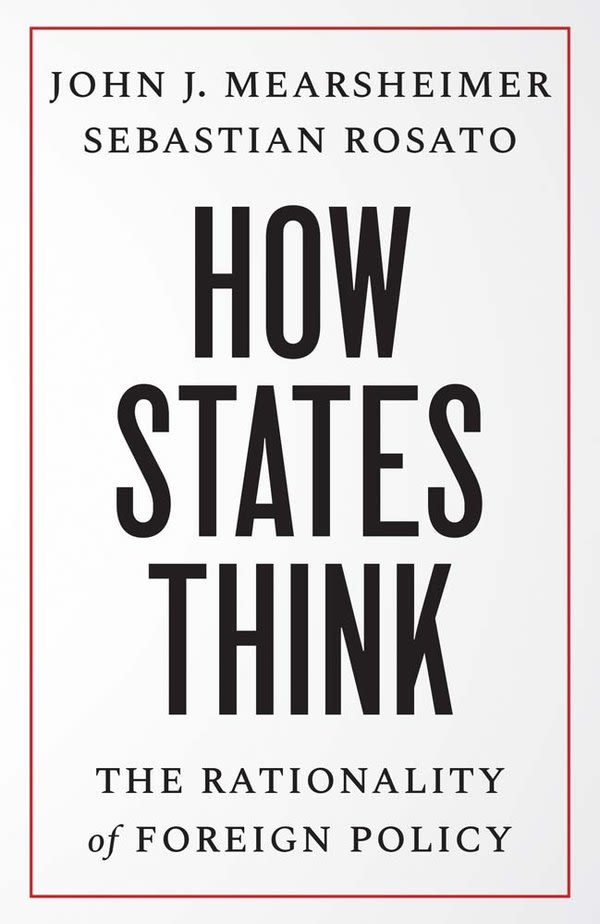
How States Think: The Rationality of Foreign Policy
by John J. Mearsheimer
Audiobook
Written by John J. Mearsheimer and Sebastian Rosato
Narrated by Mack Sanderson
Publisher Yale Press Audio
Release date Sep 5, 2023
ISBN9780300275261
John J. Mearsheimer is the R. Wendell Harrison Distinguished Service Professor of Political Science and the co-director of the Program on International Security Policy at the University of Chicago. He has published several books, including The Tragedy of Great Power Politics
My unbridled comment:
John Mearsheimer has been a very popular and helpful influencer on YouTube, explaining the causes of the conflict in West Asia, specifically the genocide in Gaza and USA-Israel war of aggression against the Islamic Republic of Iran.
This little book he’s written, with his co-author Sabastian Rosato, provides the basis and justification for his worldview, which is the belief that most great powers and their allies are rational actors.
Be this as it may, it does not explain or make any moral judgement on the historical violence of colonialism and imperialism. The cause of wars from time immemorial is linked to this phenomenon.
Today the main perpetrator of colonial & imperial violence is the world superpower, the United States of America and it’s primary ally, the colony of Israel.
Interesting questions are raised by the assumption that most nation states are rational actors on the world stage. As Mearsheimer might know or explain, a rational judgement or action might not necessarily be a moral judgement or action.
With this in mind, the answer to the question “how do states think?” could well be “like a person without a conscience”.
In other words, like a psychopath.
Psychopaths are probably more rational than empaths, based on Mearsheimer’s criteria of deliberation and calculation of national interest, this being survival (like Iran) or long term strategic security (as for Russia in Ukraine).
Based on Mearsheimer’s criteria, it could be argued that the genocide in Gaza was - through the eyes of Israeli policy makers - a rational act.
Even slavery of the 18th century, it could be argued, was a rational policy. The use of kidnapped muscle power for energy supply, before the Industrial Revolution and the development of energy from coal and oil, probably was justified on the grounds of nation building, yet it was a psychopathic phenomonon
At the end of the day, the debate about how states think seems rather academic.
It was interesting to read Mearsheimer’s categorization of the Soviet Union’s 1968 invasion of Czechoslovakia and the USA’s 1950 attack on North Korea. Also Japan’s attack on neighboring countries between 1937 and 1941, driven by a need for natural resources, imperial ambition, and a pushback against Western trade embargoes.
Plus ça change, plus c’est la même chose.
--ooOoo--
What Everand says about the book:
About this audiobook
A groundbreaking examination of a central question in international relations: Do states act rationally?
To understand world politics, you need to understand how states think. Are states rational? Much of international relations theory assumes that they are. But many scholars believe that political leaders rarely act rationally. The issue is crucial for both the study and practice of international politics, for only if states are rational can scholars and policymakers understand and predict their behavior.
John J. Mearsheimer and Sebastian Rosato argue that rational decisions in international politics rest on credible theories about how the world works and emerge from deliberative decision‑making processes. Using these criteria, they conclude that most states are rational most of the time, even if they are not always successful. Mearsheimer and Rosato make the case for their position, examining whether past and present world leaders, including George W. Bush and Vladimir Putin, have acted rationally in the context of momentous historical events, including both world wars, the Cold War, and the post–Cold War era.
By examining this fundamental concept in a novel and comprehensive manner, Mearsheimer and Rosato show how leaders think, and how to make policy for dealing with other states.