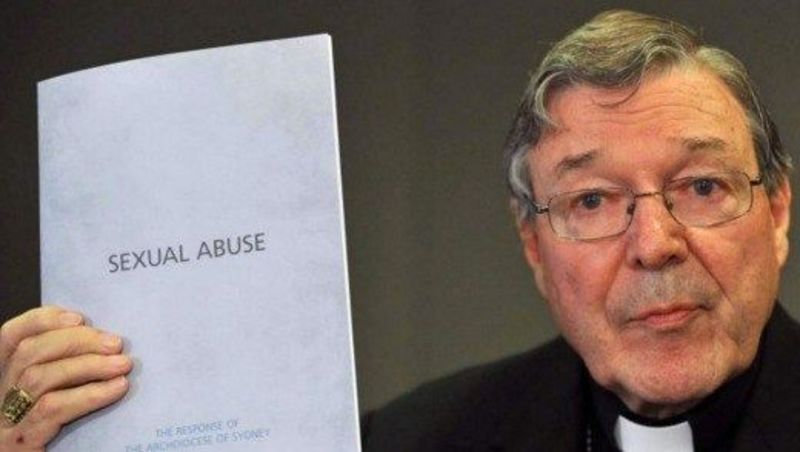
George Pell takes the wrap for the Church's homosexual priests . . . and their sins

To understand the prosecutor's moral foundation for the deliberate and dubious targeting of Cardinal George Pell - the Vatican's number three man - we need to understand the philosophy of utilitarianism, popularised by John Stewart Mill (1806 - 1873).
This moral philosophy has had strong influence in the creation of Western liberalism that led to ideas of the 'welfare state'.
It is a useful and pragmatic conceptual framework in certain circumstances where difficult decisions are required, such as in the case of a triage, but it can cause harm to individuals sacrificed for the greater good.
The principal idea advanced by utilitarianism might be summarised by the line:-
Those acts are right and good which produce the greatest happiness for the greatest number of people.
And, under this philosophy, justice might be served by the jailing of an innocent person in certain circumstances. In the utilitarian view:-
Justice is the appropriate name for certain social utilities by which the general good is realised.
Though Pell may be innocent of the specific charge, even after his conviction by a jury (as was Lindy Chamberlain ) - never the less, his conviction for a preposterous alleged homosexual act in the sacristy of the Melbourne cathedral while wearing his full Bishop's regalia, can only lead to cognitive dissonance in the minds of the faithful. It is really unthinkable for most good people. Just as it is unthinkable for 9/11 to be an inside job.
The charges against the Cardinal were based on the story of an anonymous accuser from the distant past and there were no witnesses. In this scenario, one would think that a prosecution case would not be successful. It is the word of one person against the word of another. And the accuser's story was similar in nature to the fantasies of individuals who believed they witnessed satanic ritual abuse by famous figures when they were children (for example, Fiona Bartlett )
The victim must always be believed
This philosophy is often the only way a jury can make convictions in domestic violence and rape cases. The failures of this principle were illustrated recently in Australian 60-Minutes TV story (see YouTube video )
There is no need to repeat here all the details of Pell's career and his spectacular destruction. A simple click on to the Wikipedia entry will bring up the whole fact-checked story.
The Pell conviction drags the whole Catholic Church into disrepute - to the point where many Catholics are embarrassed to admit they are members of the church.
As one friend wrote to me "What 9/11 did to the minds of the 0.3 billion Americans, so Pell's conviction will do to the minds of 1.2 billion Catholics".
The Catholic Church will not be the same again.
---
What is the root cause of all these abuse problems with the Catholic clergy?
One can offer this answer: it is homosexuality.
That's defining the problem in politically incorrect terms, but it needs to be said by someone, somewhere, outside the jurisdiction of Australian anti discrimination law.
The LGBT rights lobby in Australia has a pathological hatred of the Catholic Church in general and of the counter-revolutionary George Pell in particular. This is due to the church's official doctrine on homosexuality (above), that Pell defends.
The lobby's strategy is to de-link the widespread sexual molestation of boys within the church from homosexuality.
They give it a different word, and call it pedophilia. The media go along with this.
Case law in civil anti-discrimination cases under "homosexual vilification" cases in New South Wales, Australia, have established that - under the law but not in reality - homosexuality and pedophilia are mutually exclusive characteristics. A person can be one or the other, but not both at the same time.
The reason that the issue of homosexuality within the Catholic clergy cannot be addressed in the media, is a result of anti discrimination laws. These laws have effectively normalised homosexuality - to the point where any public criticism of a person's behaviour on the grounds of their homosexualtity, is unlawful.
To understand the impetus for the targeting the Cardinal in the first place, we need to palce it in the context of the Australian Royal Commission into the sort of homosexual abuse for which Pell is accused of perpetrating.
In political terms, there needs to be some lasting and irreversible outcome from this multi-million dollar government inquiry that went on for five years
And the conviction of George Pell is the perfect outcome from a political perspective.
For all the 4,400 complaints to the Royal Commission of sexual abuse or molestation by Catholic clergy in Australia, about 80% of the alleged victims were were boys at the time, now grown men.
This 80% figure coincides with the gender break-down data from other significant inquiries into abuse by Catholic clergy, including Philidelphia and Germany .
Two recent books expose the systemic problems within the Catholic Church caused by its clergy becoming a refuge for closeted gay men who are attracted in their youth to the high-status and celibate priesthood.
Becomming a priest was was seen as an escape from the feared alternative of living in a straight world where marriage and family is seen as the normal passage to fulfillment and homosexuality seen as best kept in the closet.
Further reading:.
In the Closet o'f the Vatican: Power, Homosexuality, Hypocrisy by Federic Martel (Amazon)
Goodbye, Good Men: How Liberals Brought Corruption into the Catholic Church by Michael S. Rose (Amazon).
------------
MEDIA COVERAGE
Below are the stories that appeared in The Australian, on Thursday 22 August, 2019 - the morning that the decision was announced that Cardinal George Pell had lost his appeal against his conviction for criminal homosexual behaviour.
Appeal lost, Pell eyes High Court challenge
JOHN FERGUSON TESSA AKERMAN
MAJORITY VERDICT KEEPS CARDINAL IN JAIL - ONE JUDGE DOUBTS VICTIM’S TESTIMONY
Cardinal George Pell is weighing up a High Court challenge to his child sex abuse convictions after the Victorian Court of Appeal yesterday rejected his bid for freedom and one of the three judges questioned the evidence of his accuser.
The legal team for the disgraced cardinal is examining whether there are grounds for appealing against the decision in the High Court, the last chance to stop Pell serving a minimum three years and eight months in jail.
Pell, 78, failed yesterday in his bid to overturn his convictions for sexually assaulting two teenage choirboys when the Victorian Court of Appeal split 2-1, the majority decision keeping the cardinal in jail. This means Pell, who has served nearly six months at the Melbourne Assessment Prison, faces months more in jail before knowing whether he will get a final opportunity to clear his name in the nation’s highest court.
Two senior judges believed the evidence of Pell’s sole surviving victim, whom a jury found was sexually assaulted in a sacristy at St Patrick’s Cathedral in 1996 and again at the cathedral the next year while a choirboy.
Chief judge Anne Ferguson said she and Court of Appeal president Chris Maxwell found there was nothing in the victim’s account of Pell’s offending that meant the jury must have had a doubt as to the cardinal’s guilt.
“Throughout his evidence (he) came across as someone who was telling the truth,” Chief Justice Ferguson said.
“He did not seek to embellish his evidence or tailor it in a manner favourable to the prosecution.”
The third appeal judge, Mark Weinberg, disagreed, believing Pell should have been acquitted of all charges. Justice Weinberg, a former commonwealth director of public prosecutions, could not exclude the possibility that some of what the man, now in his 30s, had said was concocted. He said the man’s account of one of the alleged sexual assaults took “brazenness to new heights”.
“In the present case, there was a significant body of cogent evidence casting serious doubt upon the complainant’s account, both as to credibility and reliability,” he said in a 204-page dissenting judgment. “On occasion, he seemed almost to ‘clutch at straws’ in an attempt to minimise, or overcome, the obvious inconsistencies between what he had said on earlier occasions, and what the objective evidence clearly showed.”
The Vatican offered qualified support for Pell, declaring late yesterday that it would review its position on Australia’s most senior Catholic once all avenues of appeal were exhausted.
“As the proceedings continue to develop, the Holy See recalls that the cardinal has always maintained his innocence throughout the judicial process and that it is his right to appeal to the High Court,” the Holy See said.
The Australian Catholic Bishops Conference offered support for Pell and the rule of law, saying all Australians must be equal under it and accept the judgment.
A spokeswoman for Pell said he was “obviously disappointed” with the decision and his legal team would thoroughly examine the judgment to determine whether to make a special leave application to the High Court.
“While noting the 2-1 split decision, Cardinal Pell maintains his innocence. We thank his many supporters,’’ she said.
The Court of Appeal failure was embraced by sex abuse survivors. Pell’s surviving victim declared that he wanted an end to the ordeal, exacerbated by two trials and an appeal. He paid tribute to a second choirboy who was abused by Pell and died of a heroin overdose in 2014, and the other complainants who failed to substantiate their cases.
Pell was hit in 2017 with 26 charges of abuse from nine complainants.
---
Friend’s funeral fuelled pursuit of justice
MARK SCHLIEBS REMY VARGA
George Pell’s downfall began with a funeral.
A former choirboy, who had been in a dark place, had lost his life. A childhood friend who shared his secret was struggling to leave that same dark place.
After the funeral, the friend suddenly found a sense of purpose and responsibility. “I gave a statement to police because I was thinking of him and his family,” the man, one of two victims of Pell’s sexual abuse at St Patrick’s Cathedral, said yesterday.
“I felt I should say what I saw and what happened to me. I had experienced something terrible as a child, something that marked my life. I wanted at least some good to come of it.”
What came of it was the highest-ranking Catholic to be convicted for sexual abuse — a verdict yesterday upheld by Victoria’s highest court. It resulted in relief and celebration by others who had levelled separate allegations of sexual abuse against Pell, which the courts dismissed.
The father of the deceased former choirboy, who has launched a civil claim over his son’s abuse, shed tears of relief inside the crowded courtroom.
“I’m sad my son’s not here to see it,” the father said. “I'm really happy for the other victim.”
---
Death-row days after another crushing defeat
JOHN FERGUSON
George Pell moved like a man on death row.
He has aged terribly, his confidence drained.
The once meticulously combed hair rebelling.
His clerical suit creased, his vision of his future blurred; he walked slowly with his elderly ruckman’s stoop even more pronounced.
This is what prison does; it is what it is designed to do.
First to tether, then to crush.
As Pell sat in the dock, chief judge Anne Ferguson might as well have been his executioner, siding with the jury, embracing the complainant’s evidence.
At 78, we know that Pell may not survive prison.
In the 20 or so minutes that the cardinal spent in the courtroom he barely moved, save for the occasional look at the ground, a slow almost involuntary slump of the head.
Twice he looked towards his legal team, where his barrister Ruth Shann and solicitor Paul Galbally sat listening to what may yet be the cardinal’s death sentence.
On the second occasion, he appeared to nod to Shann, an act one part respect, two parts desperation.
Behind the bar table were probably 75 people; Pell’s supporters, priests, victim advocates, law students. Even some voyeurs.
Pell, to be sure, is a convicted pedophile on the sex offender registry and only the High Court can change this.
But his friends argue that whatever happened in court yesterday, he remains a man of intellect and loyalty.
His brother David drove up from the country, Pell’s niece Sarah was in the second row and his great friend, Sydney-based Chris Meaney, was in the front row, along with Pell’s loyal adviser Katrina Lee.
It is OK to feel sad for these people. They have lost a lot.
But not nearly as much as the many sex abuse victims who gathered for the court hearing, or their parents or friends.
Viv Waller, the lawyer for the complainant, was towards the front of the gallery and the relentless victims’ advocate Chrissie Foster was smack bang in the heart of the group.
Foster’s life — and family — has been smashed by Catholic abuse.
For Waller, there were no winners.
“It’s not a celebration,’’ she said. “No one wanted to be here.’’
Abuse survivor and advocate Stephen Woods was a little less restrained, declaring his network of kindred spirits were shocked by the judgment.
“I am stunned, they are just stunned and amazed,” he said.
For 15 minutes after the court was drained of judges, barristers and the public, roughly a dozen people stayed behind, very quietly confronting the new reality.
These were team Pell, the people closest to the cardinal.
It was a very private moment in a very public place; the courtroom that had just witnessed one of the most significant moments in Australian legal history.
While a woman sobbed from the back of the gallery when Ferguson delivered the judgment, there were no histrionics from the Pell camp.
Just a totally dejected group of people looking for another result.
By the time they made their way outside, William Street was heaving with maybe 200 people, mainly journalists from all around the world, also trying to make sense of what had happened.
Will this go to the High Court? What now for the cardinal?
One point not lost on the victim was the elite legal representation afforded Pell.
From the silks Robert Richter and Bret Walker down, Pell had millions spent on the fight to keep him out of jail.
The former choirboy detailed in his statement how he had never sought compensation and that Viv Waller had acted pro bono.
“I am not an advocate,’’ he said. “You wouldn’t know my name. I am not a champion for the cause of sexual abuse survivors, although I am glad those advocates are out there.’
“But that is not my path.
“After attending the funeral of my childhood friend, the other choirboy, I felt a responsibility to come forward. I knew he had been in a dark place. I was in a dark place.’’
That darkness turned to vindication yesterday.
For the choirboy, Waller and police.
---
THE CASES FOR AND AGAINST THE APPEAL
President of the Court of Appeal judge Chris Maxwell, left, Chief Justice Anne Ferguson and judge Mark Weinberg deliver the verdict yesterday
Ferguson/Maxwell decision: rejecting the appeal
- Evidence of the victim was compelling with explanations for gaps in memory having a ‘ring of truth’
Throughout his evidence, ‘A’ came across as someone who was telling the truth. He did not seek to embellish his evidence or tailor it in a manner favourable to the prosecution. As might have been expected, there were some things which he could remember and many things which he could not. And his explanations of why that was so had the ring of truth.
- Evidence of the church witnesses as to what happened had ‘general consistency and substantial mutual support’ which was unsurprising due to nature of religious ritual and practice
We accept that there was general consistency, and substantial mutual support, in ‘the picture they painted’ of what occurred at the cathedral before, during and after Sunday mass in the period when Cardinal Pell was archbishop. This is, of course, unsurprising since a defining feature of religious observance is adherence to ritual and compliance with established practice.
- There was good reason for the victim to specifically remember incidents
In contrast to the ‘standing on the steps’ ritual, there were only two incidents for ‘A’ to remember. Given the nature of those events, there was a very good reason for him to recollect them.
- It was quite possible the second incident with squeezing of genitals in hallway was not noticed
‘A’ confirmed that Cardinal Pell ‘did squeeze me painfully’, although he was not sure if he had let out a cry of pain ... The action as described was very brief (‘one, two, three seconds’) and it would not have required Cardinal Pell to do more than pause momentarily ... it seems to us to be quite possible that this brief encounter was not noticed. At all events, the evidence once again falls well short of establishing impossibility.
Weinberg decision: supporting the appeal
- Substantial odds against the complainant’s account of abuse occurring
In order for the complainant’s account to be capable of being accepted, a number of the ‘things’ ... had to have taken place within the space of just a few minutes. In that event, the odds against the complainant’s account of how the abuse had occurred would have to be substantial ... This form of ‘probabilistic analysis’, if properly applied, suggests strongly to me that the jury, acting reasonably, on the whole of the evidence in this case, ought to have had a reasonable doubt as to the applicant’s guilt.
- Church witnesses, including parish priest Charles Portelli, remembering standing on the cathedral steps with Pell after his first Sunday mass were credible
It was reasonable to think that Portelli would have recalled standing on the steps of the cathedral after mass with the Archbishop at his first Sunday solemn mass. Accompanying the archbishop to his ‘meet and greet’ was a central part of Portelli’s role. So too was never leaving him alone, in the cathedral, while robed.
- The complainant’s account of the second incident was highly unlikely to go unseen and unreported
The complainant’s account of the second incident seems to me to take brazenness to new heights, the like of which I have not seen ... I would have thought that any prosecutor would be wary of bringing a charge of this gravity against anyone, based upon the implausible notion that a sexual assault of this kind would take place in public, and in the presence of numerous potential witnesses. Had the incident occurred in the way that the complainant alleged, it seems to me highly unlikely that none of those many persons present would have seen what was happening, or reported it in some way.
Having had regard to the whole of the evidence led at trial ... I find myself in the position of having a genuine doubt as to the applicant’s guilt.
---
Legal academics add their weight to opinion of dissenter
ANALYSIS
CHRIS MERRITT
Despite writing in dissent, judge Mark Weinberg dominated yesterday’s decision in George Pell’s appeal with a 204-page argument that can be summed up in one line: the cardinal’s conviction is unsafe.
The majority disagreed but Weinberg’s detailed and compelling dissent almost guarantees that the High Court will be asked to reexamine this case.
This massive dissent is expected to become a guide for any special leave application. Even if special leave is refused by the High Court, Weinberg’s rejection of much of the prosecution’s case is set to ensure the community’s deep divisions over this cleric are unlikely to be healed.
Legal academic Mirko Bagaric said he had been surprised that the two judges who formed the majority had not followed Weinberg, because the dissenting judge was “clearly the brightest bloke on the Victorian Court of Appeal”.
Bagaric, a professor at Swinburne University, said that Weinberg was a “powerhouse” on criminal matters and more experienced in this area than the two judges who formed the majority, chief judge Anne Ferguson and Court of Appeal president Chris Maxwell.
Weinberg would have acquitted Pell because he believed the jury verdict convicting him of historical child sex abuse was unreasonable and could not be supported having regard to the evidence.
Pell’s legal team issued a statement yesterday saying it would thoroughly examine the court’s judgment “in order to determine a special leave application to the High Court”.
Before reaching their decisions, all three judges on the Court of Appeal read 2000 pages of transcript from Pell’s trial and considered hours of recorded evidence from witnesses.
If the High Court decides to hear an appeal against yesterday’s ruling, legal academics said the judges on the nation’s highest court would be extremely unlikely to adopt that approach.
If there is another appeal, the High Court would be asked to answer the same question that confronted the Court of Appeal: on the whole of the evidence before the jury, was it reasonable to convict Pell?
That approach was set down by the High Court in a 1994 decision known as M v The Queen. The dissenting judgment lists a series of cases in which the High Court has applied the “M” test to overturn jury decisions. Yesterday’s majority judgment, which also relied on the “M” test, accepted the prosecution’s argument that the complainant who had accused Pell of homosexual abuse was a compelling witness who was neither a liar or a fantasist.
However, Weinberg listed cases where “notwithstanding the apparent credibility of a complainant in relation to an allegation of homosexual abuse, the countervailing circumstances, including any defence evidence, have led the High Court to quash the conviction and enter a verdict of acquittal”.
One senior legal academic said the differences between the majority and Weinberg were so extensive it might appear to some that they had been considering different cases.
While Ferguson and Maxwell accepted the complainant’s evidence, Weinberg wrote that Pell’s counsel, Bret Walker SC, had been justified in submitting that the complainant “did, at times embellish aspects of his account”.
“On occasion he seemed almost to ‘clutch at straws’ in an attempt to minimise, or overcome, the obvious inconsistencies between what he had said on earlier occasions and what the objective evidence clearly showed,” Weinberg wrote.
Yesterday’s ruling comes at a time when a growing number of decisions by the Victorian Court of Appeal have been overturned by the High Court.
---
Loss but Pell now eyes High Court
The choirboy said: “I would like to acknowledge my friend who passed away, the other choirboy, and pay my deep respect to him and his family. I would like to acknowledge the courage of those people who reported to the police.’’
Scott Morrison flagged Pell losing his Order of Australia medal, but the office of Governor-General David Hurley said a decision on stripping him of the award would be made only when all avenues of appeal were exhausted.
“They’ve rendered their verdict, and that’s the system of justice in this country and that must be respected,” the Prime Minister said.
“My understanding is that this would result in the stripping of the honours that are decided externally to the government.
“That is a process that is done independently, and that of course will now follow.”
The sting in the tail for survivor groups was the dissenting decision by Justice Weinberg, who was critical of the evidence of the choirboy, concluding that there was a significant possibility the crimes weren’t committed.
He added that some of the evidence might have been concocted.
Justice Weinberg was highly critical of aspects of the former choirboy’s evidence, saying he at times exaggerated his account.
While there was nothing inherently improbable about child sex abuse by senior clergy, the victim’s evidence needed to be examined within the surrounding circumstances, he said.
University of Melbourne law professor Jeremy Gans said Justice Weinberg’s dissenting judgment was significant and would be weighed up by the High Court.
He said the High Court could decide by the end of this year whether to accept the case, possibly hearing it by the middle of next year.
On the Weinberg judgment, Professor Gans said: “I am pretty sure I’ve never heard of a 200-page dissent in a criminal matter.’’
There is no automatic right to appeal but Pell’s legal team could apply for special leave. They are required to make the application within 28 days.
Pell was convicted of homosexually abusing the two teenage choirboys in a sacristy in St Patrick’s Cathedral in 1996 and 1997. The 1996 convictions related to both choirboys being abused. The 1997 conviction related only to the surviving choirboy, whose evidence was central to the Pell convictions. Pell was found guilty of groping and forced oral sex.
All three judges rejected the remaining two grounds of appeal — the exclusion of an animation of people’s movements about the cathedral and the arraignment of Pell by video link and not in the physical presence of the jury panel.
---
Time may be served alongside notorious ‘old mate’ Ridsdale
MARK SCHLIEBS
Prison authorities are considering sending George Pell to the same prison as his former housemate, notorious sex offender Gerald Ridsdale.
It’s understood Pell will remain in the Melbourne Assessment Prison — where he has been since February — while prison authorities assess where he should be placed.
The most likely destination is the Hopkins Correctional Centre in Ararat, 200km west of Melbourne, although other options are being considered.
The prison houses Ridsdale — whom Pell escorted to court in 1993 — along with other pedophiles, high-profile persons and “protected” inmates who may be targeted in other facilities. A spokesman for the Department of Justice declined to comment. “Corrections authorities conduct rigorous security and risk assessments on anyone coming into the prison system to ensure their placement is safe and secure.”
Hopkins is a medium security prison with capacity for 762 prisoners “including a number of sex offenders and some remand prisoners”.
---
Judge casts doubt on victim’s credibility
DISSENTING VIEW
TESSA AKERMAN
One of the three judges hearing George Pell’s appeal would have ordered he be acquitted, given what he described as a “significant body of cogent evidence” casting serious doubt on the victim’s account.
In his dissenting ruling, judge Mark Weinberg said the case was unusual, depending entirely upon the victim being accepted beyond reasonable doubt as a credible and reliable witness.
“Yet the jury were invited to accept his evidence without there being any independent support for it,” he wrote.
Justice Weinberg said the victim at times embellished aspects of his account. “On occasion, he seemed almost to ‘clutch at straws’ in an attempt to minimise, or overcome, the obvious inconsistencies between what he had said on earlier occasions, and what the objective evidence clearly showed.”
He said while there was nothing inherently improbable about child sex abuse by senior clergy, the victim’s evidence needed to be examined within the surrounding circumstances.
“In the present case, there was a significant body of cogent evidence casting serious doubt upon the complainant’s account, both as to credibility and reliability,” the judge said.
Justice Weinberg said the prosecution’s case was challenged by accepted testimony of a significant number of witnesses, “all of whom were of good character and reputable”.
He said the possibility of the abuse occurring in the priests’ sacristy was reliant on several factors, including whether Pell was always accompanied by parish priest Monsignor Charles Portelli. It also rested on evidence that the area was a “hive of activity” shortly after Sunday Solemn Mass.
“Even the ‘reasonable possibility’ that what the witnesses who testified to these matters may have been true must inevitably have led to an acquittal,” Justice Weinberg said. “That was because the complainant’s account could not be reconciled at all with any such finding.”
Justice Weinberg said a jury couldn’t put mistakes in the victim’s evidence aside as “nothing more than matters at the periphery”.
“Sometimes an approach of that kind may be justified. It does not, however, absolve this court from its duty of carrying out a full and proper assessment of the whole of the evidence, including matters of detail,” he said.
Justice Weinberg said it was always going to be a “problematic case”. “The complainant’s allegations against the applicant were, to one degree or another, implausible. In the case of the second incident, even that is an understatement,” he said.
The second incident involved Pell pushing the victim against the wall of a public hallway and squeezing his genitals.
“The complainant’s account of the second incident seems to me to take brazenness to new heights, the like of which I have not seen,” Justice Weinberg. He said Pell’s denials that he was an abuser in the record of interview were “forceful and persuasive”.
Justice Weinberg said the findings of the Royal Commission into Institutional Responses to Child Sexual Abuse represented a “shocking indictment of clerical abuse” in Australia.
He noted he was troubled by the fact that he differed from his colleagues, chief judge Anne Ferguson and judge Chris Maxwell.
“That has caused me to reflect even more carefully upon the proper outcome of this application,” he said. “Having done so, however, I cannot, in good conscience, do other than to maintain my dissent.”
---
Convinced by witness who spoke ‘the truth’
MAJORITY VIEW
TESSA AKERMAN
The two Victorian Court of Appeal judges who upheld the trial jury’s verdict said George Pell’s victim was a “compelling witness” whose evidence “had the ring of truth”.
Lawyers for Pell had argued the victim had fabricated his story but in a majority verdict yesterday chief judge Anne Ferguson and president of the court Chris Maxwell rejected that submission.
In their judgment they accepted that the victim had buried his memories of being abused in the priests’ sacristy after getting caught by Pell drinking sacramental wine with a fellow choirboy, who has since died.
The victim gave evidence that he had compartmentalised the two incidents of abuse and pushed them “away from my normality”.
“It’s something I’ve carried for the whole of my life … (and took) courage much later on for me to be able to even think about coming forward,” the former choirboy said.
He said he did not report the abuse until 2015.
Chief Justice Ferguson and Justice Maxwell said the victim had been caught “red-handed” drinking the wine in a prohibited place and anything he said about Pell “was almost certain to be disbelieved”.
“In our view, this was a very significant part of (the victim’s) evidence,” they said.
“It was rightly characterised as compelling, both because of the clarity and cogency of what (the victim) said and because of the complete absence of any indication of contrivance in the emotion which (the victim) conveyed when giving his answers.”
Chief Justice Ferguson and Justice Maxwell said the victim came across as someone telling the truth and his explanations for not remembering some things yet remembering others “had the ring of truth”. “He did not seek to embellish his evidence or tailor it in a manner favourable to the prosecution,” they said. “We were not prompted at any stage to doubt the veracity of his evidence.”
They said the victim correctly identified where the wine area was in the priests’ sacristy and recalled in some detail the layout and furnishing of the alcove where Pell discovered him and his fellow choirboy.
He also placed the abuse as occurring in the priests’ sacristy that was temporarily used at the end of 1996 by Pell while the archbishop’s sacristy was being renovated.
“In our view, the jury were entitled to view these ‘undisputed facts’ as independent confirmation of (the victim’s) account of having been in the priests’ sacristy in that period,” the judgment said.
According to Chief Justice Ferguson and Justice Maxwell, there were also a number of reasons for the victim to remember particular conduct but the recollection of the other witnesses, including church staff and choristers, must “necessarily be affected by their recollection of the ritual that developed thereafter”.
They said the evidence of the witnesses only confirmed that what the victim alleged wasn’t impossible but allowed that the defence’s arguments of implausibility or improbability were powerful.
“It was, of course, highly improbable that someone in Cardinal Pell’s position would have acted in the way alleged, in the circumstances in which he was alleged to have done so,” they said.
“In the first incident, there was a high risk of discovery; there was a high risk that one or other of the boys would cry out; and there was a high risk they would report him. The risk to his reputation, and position, was enormous.” They found it was “open to the jury to be satisfied of Cardinal Pell’s guilt beyond reasonable doubt’’.
---
Justice a true salve for wounds of old
ADVOCATES
REMY VARGA
AAP, MARK STEWART
A supporter of abuse victims, above; Julie Cameron, below; Rob Walsh and Chrissie Foster, left
Screams of joy erupted outside Victoria’s Supreme Court when news broke that George Pell would not be walking out the front door a free man, with the appeal decision welcomed by organisations supporting victims of abuse.
Long-time abuse victims’ advocate Chrissie Foster emerged from court smiling to say the 2-1 verdict proved no one was untouchable before the law: “This is a very high-profile, very powerful person. In the church, in the Vatican, surrounded by all of that, and how much money he has, he’s got the power, the best defence money could buy. Yet that did not convince the jury to find him innocent.
“To have that upheld is just outstanding.”
She said questions now had to be asked about the Melbourne Response compensation scheme, of which Pell was an architect. “We’re looking at a system … put in place by a pedophile. What would be his motive behind it?” she said.
Robert House, from the Care Leavers Australia Network, said the decision meant victims were finally being delivered after living decades in silence.
“We were for decades not believed and now we are believed and that is wonderful,” he said.
A spokesman for The Blue Knot Foundation said the conviction being upheld would restore people’s faith in the justice system: “For survivors, a conviction being upheld against a high-profile once powerful perpetrator underlines faith in the justice process and the possibility of speaking out.”
Michael Advocate, a victims’ abuse advocate who uses a pseudonym, used a megaphone to express his joy to commuters on Lonsdale Street: “All I can say is I may not be smiling but I’m laughing on the inside because justice has been served.”
Survivors Network of those Abused by Priests spokesman Steven Spaner said he hoped the Appeal Court judgment would encourage other church abuse victims to come forward, find help and start healing.
---
Report on deaths exaggerated
SUICIDES
JOHN FERGUSON
Ashton
A confidential police investigation into claims of suicides linked to Catholic sex abuse that helped trigger the downfall of George Pell found the issue had been exaggerated and lacked evidence.
Police claimed in early 2012 that dozens of people killed themselves as a result of Catholic clergy sex abuse, mainly in the diocese of Ballarat in western Victoria.
The claims rocked the church and were instrumental in the formation of the state parliamentary inquiry into sex abuse, which ultimately played a major role in Pell’s downfall. It was during that inquiry that police set up the operation to investigate whether there were abuse allegations against Pell that could be prosecuted.
When senior police initially investigated the suicide claims, they found the original 2012 report had vastly overstated the number of clergy-related suicide deaths. Police ordered another examination of the claims with the aim of providing information to the coroner to update records. The Australian has seen a confidential letter written by now Victoria Police Chief Commissioner Graham Ashton in which he is critical of the original police claims and confirms that only one case was officially established of a Catholic abuse victim killing themself as a result of the offending.
The first police review of the report, Operation Plangere, found serious deficiencies. It was written in November 2012 and Leading Senior Constable Tania Siegemund was damning of the original claims. “There are significant limitations to the data supplied by (the force) which have resulted in a significant number of the nominated premature deaths for review remaining unable to be verified, as the persons of interest are unidentifiable,’’ she found.
After Operation Plangere was finished, Mr Ashton, then a deputy commissioner, wrote to the parliamentary abuse committee in July 2013 after police conducted further inquiries for the coroner. He declared in the letter, seen byThe Australian, that the original police report claiming widespread clergy suicides was “overstated, lacking in evidentiary basis and detail’’.
The original suicide report also had lacked meaningful detail, Mr Ashton said. “As earlier indicated, the level of detail provided in the original list was minimal at best and very much based on anecdotal information from varied sources,’’ he wrote to the committee.
The later police report determined that 23 of 43 people identified had died from suicide but only one suicide could definitely be linked with Catholic abuse.
A spokesman for Mr Ashton said yesterday that while only one case of suicide could be conclusively linked to child sex abuse at the hands of clergy to the coronial standard, there were other cases of suicide that could never be attributed “one way or another’’.
“Chief Commissioner Graham Ashton remains grateful to the police in Ballarat for their tireless work thoroughly investigating these matters,’’ the spokesman said.
If you or someone you know is at risk of suicide, call Lifeline (13 11 14) or the Suicide Call Back Service (1300 659 467), or see a doctor
---
Split decisions among jurors, legal commentators and judges add up to doubt
ANALYSIS
TESS LIVINGSTONE
Beyond reasonable doubt? Not in the view of judge Mark Weinberg, the most experienced criminal law jurist of the three Victorian Court of Appeal judges who heard Pell v The Queen.
Across 204 pages of the 324-page judgment, Weinberg, who was in a minority, dissected the details of the case forensically, concluding the verdict was unsafe.
In a combined 120-page finding, his fellow judges, Anne Ferguson and Chris Maxwell, believed otherwise, concluding it was “open to the jury to be satisfied of Pell’s guilt beyond reasonable doubt’’.
Pell’s successor as Archbishop of Sydney, Anthony Fisher, a lawyer, said the split decision was consistent with the differing views of the juries in the cardinal’s first and second trials and divided opinion among legal commentators and the general public.
As Fisher said, Pell continues to “strenuously maintain his innocence’’ and many will struggle to reconcile yesterday’s outcome with the man they know.
In Melbourne, Archbishop Peter Comensoli, whose career was also mentored by the cardinal, took a different approach.
His “thoughts and prayers’’ were “with the man who brought this matter before the courts’’.
In “Christian charity’’, he pledged pastoral and spiritual support to the cardinal, and also to his accuser, should he seek it.
Among those shaken by yesterday’s ruling, “if onlys’’ abounded.
If only the jury had been taken through the cathedral sacristy on a Sunday morning when it was as busy as Bourke Street instead of on a quiet weekday when its gothic corridors were as quiet as Hogwarts in the school holidays.
If only the cardinal’s defence team had encouraged him to take the stand in his full vestments.
If only two laywomen who were working metres from the priest’s sacristy on Sunday mornings in late 1996 had been called as witnesses.
Pell, outwardly, remained stoic after yesterday’s decision. He wanted to know his friends were OK.
In solitary confinement for 23 hours a day, where he has not attended mass since he last offered it on the morning of February 27, his faith has sustained him, as he has told close friends on the phone and during visits. In a recent letter, he wrote: “The knowledge that my small suffering can be used for good purposes through being joined to Jesus’s suffering gives me purpose and direction.’’
Tess Livingstone’s biography of George Pell was published in 2002.
---
Optimism for church, very little for Pell
ANALYSIS
JOHN FERGUSON
The Court of Appeal decision creates a cost and opportunity for the Catholic Church.
Its historically most significant leader is now jailed for a minimum of three years and eight months, with a greatly diminished opportunity of walking early. The brand damage to the church is profound.
But, in a strange way, Pell’s ongoing incarceration at least gives the church a starting point for rehabilitation. As long as 78-year-old Pell has been fighting these charges, and the doubt about their validity has lingered, the case has held back the church as it has tried to recalibrate in an increasingly hostile and bewildered community.
The Australian Catholic Bishops Conference now has a platform for renewal on the abuse question in the months between now and whenever any High Court appeal might be heard.
None of this is to paint over the weeping sadness of this story.
The lives of two choirboys were severely impacted. One is dead. The greatest career in the Australian church is in smoking ruins. Millions of Catholics are wondering when, if, it will all end.
But Pell’s absence while incarcerated, at least until any High Court appeal, gives ACBC president Mark Coleridge and others time to create a meaningful platform for taking the church forward.
It must be contemporary and appeal to a broader constituency.
The question of how to handle the Court of Appeal judgment is vexed. Justice Mark Weinberg’s dissenting views are strong and will give Pell some hope but they weren’t enough to sway the other two judges. The impact on Pell is profound. The court’s 2-1 finding has blocked any hope of Pell leaving prison early to rebuild his life and place in the church.
Pell’s legacy is fundamentally stained by the sex abuse convictions. This is the unavoidable conclusion of yesterday’s judgment.
A thick fog of bewilderment descended on court 15 as Chief Justice Anne Ferguson detailed the split decision and the firm belief of two of the judges that the complainant was compelling and told the truth. This has been the pattern of the Pell convictions. When the former choirboy gave videolink evidence in the first County Court trial, word quickly spread that the prosecution had a man that a jury could believe. The second jury was unanimous in its belief in the choirboy.
Even if the facts of the case had looked at times somewhat questionable, it was the victim that carried this case and sent Pell to jail. No matter what may happen in any High Court action, it is hard to see how he can recover his reputation, even if freed some time in 2020 or 2021.
For more than two years now, Pell’s closest supporters have been optimistic that the sex abuse charges would collapse. One way or another. There is no doubt that Pell’s legal team believed in his cause and probably still does.
A close look at the cathedral homosexual abuse evidence certainly raises questions about the plausibility of the attacks.
These questions are not erased by yesterday’s judgment.
But the reality is that a County Court jury and now the Court of Appeal ruled against Pell.
He had the best lawyers in the land and they still couldn’t keep him out of jail. There is no reason to assume the High Court would be any different.
---
Royal commission may soon reveal dark secrets
REDACTIONS
JOHN FERGUSON
The redacted sections of the royal commission into child sex abuse that relate to George Pell are now a significant step closer to being made public.
Attorney-General Christian Porter will take advice from Victorian prosecutors before releasing any information that could relate to Cardinal George Pell.
It will be up to Victorian Director of Public Prosecutions Kerri Judd QC to decide whether any of the information is necessary for future prosecutions.
This could depend in part on whether the Court of Appeal decision is appealed in the High Court.
It has been widely speculated the matter would be taken to the Court of Appeal regardless of who lost the case. There is no guarantee an appeal would be heard even though the case is widely seen as one of the most significant in Australian legal history.
Pell was heavily scrutinised by the royal commission over what he knew and when, and what he did to prevent offending by the homosexual priests Peter Searson and Gerald Ridsdale.
The commission’s report into Searson is heavily blacked out but mentions Pell as having left the Ballarat diocese to be ordained as an auxiliary bishop in the Archdiocese of Melbourne.
The appointment included Searson’s parish of Doveton, in Melbourne’s southeast. Counsel assisting the royal commission claimed Pell knew about Searson’s offending but failed to act.
“It was incumbent on Cardinal Pell, having regard to his responsibilities as auxiliary bishop, including for the welfare of children in the parish, to take such action as he could to advocate that Searson be removed or suspended or, at least, that a thorough investigation be undertaken,’’ counsel told the commission.
Searson’s offending included carrying a gun at school, killing animals and showing children a body in a coffin. He died aged 86 in 2009 without facing child sex abuse charges. He was accused of multiple cases of sex abuse.
Pell is a former friend of Ridsdale and the relationship has plagued Pell. Aged 85, Ridsdale has offended against hundreds of boys and girls and is never likely to leave jail.
---
Nation’s highest honour likely to be taken away
REPERCUSSIONS
REMY VARGA
George Pell is about to fall in with an inauspicious crowd of people who have had their honours stripped, after an appeal against his conviction for child sex abuse failed in Victoria’s Supreme Court yesterday ››
Scott Morrison said the Appeal Court’s decision to quash the appeal meant the disgraced cardinal could lose his honours, which include his Companion of the Order of Australia, the nation’s highest honour.
“The courts have done their job, they’ve rendered their verdict (and) that’s the system of justice in the country that must be respected,” the Prime Minister said.
“Of course, in my understanding that means the stripping of the honours happens externally to the government. That is a process that’s done independent and that of course will now follow.”
Mr Morrison said his sympathies lay with the survivors of child sex abuse.
Pell received his AC in 2005 for his service to the Catholic Church domestically and internationally, and for raising debate on matters of an ethical and spiritual nature, education and social justice.
Others who have been stripped of their honours include former children’s entertainer Rolf Harris, who was convicted of indecent assault, disgraced business tycoon Alan Bond and former judge Marcus Einfeld, who was jailed for lying over a speeding ticket.
Governor-General David Hurley said he could remove honours after all legal proceedings concluded. “Appointments to the Order of Australia may be terminated and one of the grounds is conviction for a crime or offence under a law of the commonwealth, state or territory,” he said.
“Once all legal proceedings have run their course, the Council for the Order of Australia may make a recommendation to me as chancellor of the order, which I will act on.”
Pell’s spokeswoman, Katrina Lee, yesterday flagged a potential appeal to the High Court and said Pell maintained his innocence.
---
Prayers for victims … and the guilty
CHURCHES
RACHEL BAXENDALE DAVID PENBERTHY
As Australian bishops said they accepted the Victorian Court of Appeal’s decision to keep George Pell behind bars, the Vatican reiterated that he had always maintained his innocence, upholding his right to keep fighting to the High Court.
Holy See press office director Matteo Bruni said the Vatican respected the Australian judicial system and acknowledged the court’s decision.
“As the proceedings continue to develop, the Holy See recalls that the cardinal has always maintained his innocence throughout the judicial process and that it is his right to appeal to the High Court,” Mr Bruni said in a statement translated from his original Italian. “At this time, together with the church in Australia, the Holy See confirms its closeness to the victims of sexual abuse and its commitment to pursue, through the competent ecclesiastical authorities, those members of the clergy who commit such abuse.”
Australian Catholic Bishops Conference president Mark Coleridge said the bishops believed all Australians must be equal under the law and accepted the judgment against Pell accordingly.
The Archbishop of Brisbane said the bishops realised this has been and remained “a most difficult time” for survivors of child sexual abuse and those who support them.
“We acknowledge the pain that those abused by clergy have experienced through the long process of the trials and appeal of Cardinal Pell,” Archbishop Coleridge said. “We also acknowledge that this judgment will be distressing to many people.
“We remain committed to doing everything we can to bring healing to those who have suffered greatly and to ensuring Catholic settings are the safest possible places for all people, but especially for children and vulnerable adults.”
Melbourne’s most senior Catholic, Archbishop Peter Comensoli, said he was “respectfully receiving” the court’s decision to reject Pell’s appeal, and his thoughts and prayers were with Pell’s surviving victim.
“That there have been two trials, and now today’s decision in the Court of Appeal: the complexity of the search for the truth in this matter has tested many, and may very well continue to do so,” he said.
“My thoughts and prayers are with the man who brought this matter before the courts.
“I humbly acknowledge it has been a challenging time for him, and I stand ready to offer pastoral and spiritual help, should he seek it.
“In Christian charity, I will ensure that Cardinal Pell is provided pastoral and spiritual support while he serves the remainder of his sentence, according to the teaching and example of Jesus to visit those in prison.”
In South Australia, Catholics have been urged to pray for the victims in the Pell case — but also to pray for the disgraced cardinal — in a letter sent to parishioners by the Archdiocese of Adelaide.
Bishop Greg O’Kelly, the apostolic administrator of the archdiocese of Adelaide, wrote to the state’s Catholics yesterday also promising that the church would redouble its efforts to ensure children were safe in its care.
While respectful of the Victorian Court of Appeal’s decision, the letter also noted it was not a unanimous one and that Pell had the right to consider his options.
“There is a possibility of further appeal,” the letter states. “I am very aware that this decision will give rise to a range of responses from people and that there will be intense and emotive media coverage of the outcome.
“In any of our discussions and commentary we need to carefully consider, and be sensitive to, the needs of all, in particular the survivors of abuse and their families.”
Bishop O’Kelly acknowledged the standing of the church had been damaged by the case and others like it.
His statement came after a tumultuous period in the church in South Australia, with Bishop O’Kelly taking over as apostolic administrator in June last year as former archbishop Philip Wilson was continuing what would ultimately be a successful fight against charges of concealing child abuse within the church.
The Archbishop of Sydney, Anthony Fisher, said the 2-1 appeal decision was consistent with differing views surrounding Pell’s case, and urged “calm and civility” in response to the verdict.
“Reasonable people have taken different views when presented with the same evidence and I urge everyone to maintain calm and civility,” he said.
‘My thoughts and prayers are with the man who brought this matter before the courts’
PETER COMENSOLI
MELBOURNE ARCHBISHOP
---
Survivor hopes ‘it’s just all over now’
VICTIMS
MARK SCHLIEBS REMY VARGA
The surviving victim of George Pell’s abuse at Melbourne’s St Patrick’s Cathedral hopes the matter will end with yesterday’s Victoria Court of Appeal decision.
The former choirboy, who along with another boy was assaulted by Pell more than 20 years ago, said he recently became a father and needed “to define myself away from all of this”.
“The criminal process has been stressful,” he said in a statement released by his lawyer, Vivian Waller. “The journey has taken me to places that, in my darkest moments, I feared I could not return from. The justice machine rolls on with all of its processes and punditry, almost forgetting about the people at the heart of the matter.
“Despite this, I appreciate that the criminal process afforded Pell every opportunity to challenge the charges and to be heard. I am glad he had the best legal representation money can buy. There are a lot of checks and balances in the criminal justice system and the appeal process is one of them.
“I just hope that it is all over now.”
He said he felt compelled to report the matter after the other choirboy died in 2014.
“I gave a statement to police because I was thinking of him and his family,” he said.
“I felt I should say what I saw and what happened to me. I had experienced something terrible as a child, something that marked my life.
“I wanted at least some good to come of it.”
The father of the deceased former choirboy, who has launched a civil claim over his son’s abuse, shed tears of relief inside the crowded courtroom.
“I’m sad my son’s not here to see it,” the father said.
“I'm really happy for the other victim, I’m really happy for him.
“(For) myself, that was a great load lifted off my shoulders … almost like somebody was massaging my shoulders and the knot came out.
“It’s not going to bring him back but to get a verdict like that is absolutely amazing.”
The deceased’s father said yesterday’s verdict vindicated the lives of the former choirboys, who were 13 when they were assaulted.
“Something must have happened to those boys because my son suffered a lot of torment,” he said. “It destroyed my marriage, it destroyed my ex-wife’s life and my daughter’s … and my son, of course.”
His son’s friend and fellow victim was not in court.
The man said the abuse had “battered” his faith but not destroyed it.
“Some commentators have suggested that I reported to the police somehow for my own personal gain,” he said.
“Nothing could be further from the truth. I have risked my privacy, my health, my wellbeing, my family. I have not instructed any solicitor in relation to a claim for compensation. This is not about money, and never has been.
“I would like to acknowledge my friend who passed away, the other choirboy, and pay my deep respect to him and to his family.
“I would like to acknowledge the courage of those people who reported to the police. For one reason or another, your cases were not advanced. My heart goes out to all of you.”
---
[ends]
The latest reports from Portugal corroborate Australian Royal Commission findings that pederasty (i.e., homosexual act by priests) was the cause of abuse.
https://www.reuters.com/world/europe/thousands-abu…
Most perpetrators (77%) were priests and most of the victims were men, Strecht said, adding that they were abused in Catholic schools, churches, priests' homes, confessionals, among other locations.
Sent from my iPhone

Widespread child abuse by Catholic Church members in Portugal is tip of iceberg - report
At least 4,815 children were sexually abused by members of the Portuguese Catholic Church - mostly priests - over the past 70 years, a report by the commission investigating the issue said on Monday, adding the findings are the tip of the iceberg.
ReutersDefying Wokism at Cardinal Pell’s funeral | The Spectator Australia
https://www.spectator.com.au/2023/02/defying-wokis…
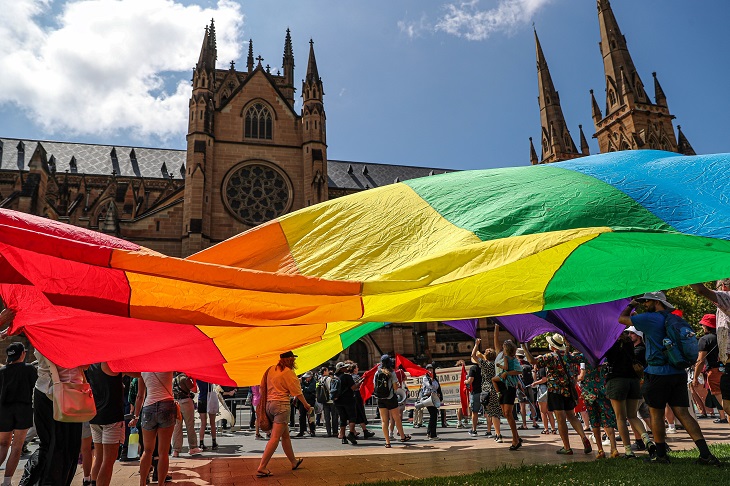
Defying Wokism at Cardinal Pell’s funeral | The Spectator Australia
As the funeral of Cardinal George Pell commenced with a procession of clergy and the singing of the great Wesleyan hymn Love Divine, Loves Excelling – shouts and the din of protest outside were heard…
The Spectator Australia
CIRCUMSTANTIAL EVIDENCE IN NOVEMBER 2022 SUGGESTS CORRUPT CARDINALS IN THE VATICAN FINANCED THE 2019 AUSTRALIAN TRUMPED-UP CHARGES AGAINST HIM
https://fifthestatepress.com/posts/status-20221110…
George Pell takes the wrap for the Church’s homosexual priests . . . and their sins
Church sins and secrets exposed in battle with Vatican `mafia’ EXCLUSIVE PAOLA TOTARO First published in The Australian newspaper, Friday, November 11, 2022 The Vatican’s first auditor-general, Libero Milone, has launched a multi-million-euro lawsuit against the Holy See, warning he will not be inti…
Fifth Estate PressPell is seen by so-called progressive leftists as a man representing the oppressive Christian hetero-patriarchy. He is hated by post-modern feminists, LGBT & climate activists as a result.
From Wikipedia
Climate Change
In a 2006 speech, Pell said that "hysterical and extreme claims" about the natural environment were the result of the "pagan emptiness" of Western culture. He said: "In the past pagans sacrificed animals and even humans in vain attempts to placate capricious and cruel gods. Today they demand a reduction in carbon dioxide emissions."[79] In a 2007 article for the Sydney Sunday Telegraph, Pell wrote that while climate had changed, he was "certainly sceptical about extravagant claims of impending man-made climatic catastrophes, because the evidence is insufficient".
LGBT issues
In 1990, Pell stated publicly that while he recognised that homosexuality existed, such activity was nevertheless wrong and "for the good of society it should not be encouraged." He has also expressed his belief that suicide rates among LGBT youth were a reason to discourage homosexuality, arguing that "Homosexual activity is a much greater health hazard than smoking." In 1998, Pell refused communion to members of the Rainbow Sash Movement who had attended Mass at the cathedral in Melbourne. He publicly rebuked their actions to the applause of other parishioners. Pell opposed Australian legislation in 2006 that would have permitted LGBT couples to adopt children. In 2007, he said that discrimination against LGBT people was not comparable to that against racial minorities.
I will park this thesis here, pending further review.
In a recent anti discrimination (homosexual vilification) decision put out by the Australian Capital Territory Civil & Administrative Tribunal, it was ruled that a tweet put out by the respondent, relating to abuse within the Catholic Church, was unlawful homosexual vilification, under section 67A of the Australian Capital Territory Anti Discrimination Act.
The tweet asserted that the historic indecent abuse of boys by Catholic priests was caused by homosexuality within the priesthood. The tweet cited evidence from the "Royal Commission" and this was deemed by the Tribunal not to be evidence.
The case: KERSLAKE v SUNOL (Discrimination) [2022] ACAT 40 (published 16 May 2022)
Disclaimer: this text has not been read by the poster as yet, to determine whether or not it is credible.
https://archive.org/stream/the-rite-of-sodomy-homo…

Full text of “The Rite of Sodomy: Homosexuality and the Roman Catholic Church”
Internet Archive
This is a very important topic - it needs more attention.
So much verbiage has been expended in this case and yet Pell's conviction boils down to the conclusion that his accuser's testimony had "a ring of truth".
Pell's ludicrous conviction erodes the entire edifice of law. And this is true, whether or not you like the man, whether you are gay or straight, left-wing or conservative.
This conviction must and will be overturned, but that will most definitely not be the end of this case.
There will be mass hysteria from those who have completely bought in to the corrupt process by which he was charged and convicted.
There will be righteous anger from conservatives and Catholics who will seek retribution.
It is almost a recipe for civil war.
Almost... but most people will ignore the whole issue as any engagement in it is emotionally damaging. We have been conditioned as a society to simply go along with the majority. It is the only way to survive.
There are now so many treacherous controversial issues which divide society that a regular tax paying citizen is befuddled to the point that they simply stop thinking. This numbed state is perfect for those who pull the strings of power. It is the desired outcome.