Empire: A Very Short Introduction
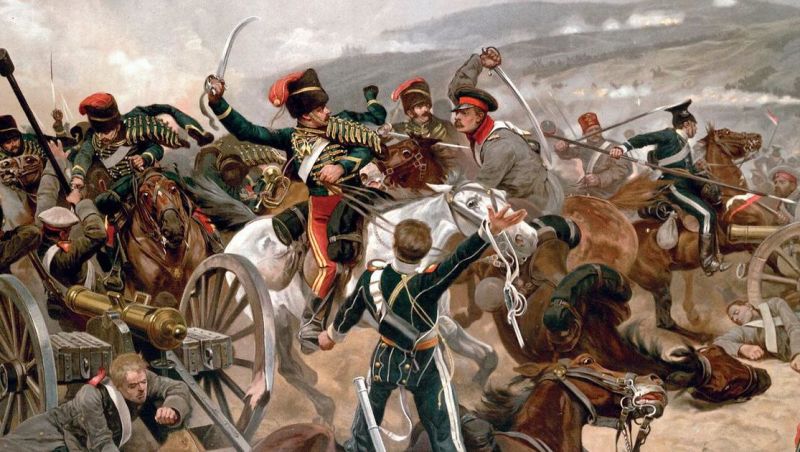
Hero image: British cavalry charging against Russian forces at Balaclava in 1854 (The Relief of the Light Brigade / Public Domain)
The Book

Title: Empire: A Very Short Introduction
Author: Stephen Howe
Publisher: Tantor Media, Inc
Release date: Jun 8, 2021
ISBN: 9781666114287
Web source: Everand
Stephen Howe interprets the meaning of the idea of "empire" through the ages, disentangling the multiple uses and abuses of the labels "empire" and "colonialism," etc., and examines the aftermath of imperialism on the contemporary world.
- from Everand
Comment
I read this audiobook in 2024, during the worst period of the disproportionate violence perpetrated by nuclear-armed and US-backed Israel, against the indigenous and defenseless Palestinian people in the territory of Gaza.
In November 1947 the enclave of European settlers and refugees from Nazi Germany - set up in the British Mandate of Palestine - was turned into a nation state, and named Israel, by a vote of 33 out of 46 votes in the fledging United Nations international organization aimed at preventing wars of agression.
All Arab nations surrounding Palestine, namely Egypt, Iraq, Lebanon, Saudi Arabia, Syria, Yemen, and Jordan - were opposed to a hostile and ethno-supremicist state created in their midst, by UN-members constituting the Anglo-American Empire.
After reading this book, we can see that - taking the long view of history - this state of Israel appears to be a legacy - or consequence - of the breakup of the former British Empire after World War 2.
Now, the small, but lethally armed, nation of Israel has become a de facto extension of the American Empire.
This book can help us understand the root cause of wars of conquest that have been with us since time immemorial due to the phenomonon of empire.
The author, Stephen Howe, being a UK professor in the history and culture of empires throughout recorded history, is eminently qualified to assist our understanding of this reality through the lens colonialism and imperialism (that are the means that empires maintain and expand their power and control of people and resources).
“Ignorance is bliss” goes the saying of the 18th century English poet Thomas Gray. However, in the 21st century, we cannot stay blissful all the time, unless we get off the internet and stop reading newspapers.
We can turn our back on the external world of geopolitics, and live in gratitude for our freedom, independence and happiness - if we are lucky enough to achieve those values in adult life.
The internet, through social media, exposes us to the horror of industrial-scale imperial destruction and mass-murder. This is made possible through dissemination of video evidence from the ubiquitous smartphone possessed by many victims and observers in a war zone.

This book by professor Stephen Howe can assist our mental health, by giving us a broader perspective on man’s inhumanity to man, arising from the phenomena of colonialism and empire-building that has been going on since time immemorial.
The Old Testament - as a historical record accepted by many adherents of the Abrahamic religions (Christianity, Judaism and Islam) - is a chonicle of the clash of empires, namely the Egyption, Assyrian, Babylonian and Israelite empires.
Wikipedia has a comprehensive analysis of this phenomonon under the heading Empire, for those inclined to go down this particular rabbit hole (link here).
We can accept non-moral evil - like cancer or mass-killing caused by an earthquake - but due to our Christian ethos, we have difficulty accepting moral evil (as perpetrated by the most moral army in the world, in Gaza)
This book is a sweeping story of the rise and fall of empires throughout recorded history. It jumps about through space and time because it is focused more on the overall phenomenon, rather than the specific details.
The details would require many volumes of an encyclopedia.
If anything, this book could be somewhat therapeutic for people upset by the behavior of empires, by helping them to accept what they cannot change.
The American Empire - the world's youngest empire and probably the most short-lived - has now joined up with Israel - the offspring of the British Empire - to conquer the Islamic Republic of Iran, the offspring of the Persian Empire.
That’s how it goes, everybody knows . . . to quote from Leonard Cohen's haunting song Leonard Cohen's song
---
Cut & paste from Everand site:
A great deal of the world's history is the history of empires. Indeed it could be said that all history is colonial history, if one takes a broad enough definition and goes far enough back. And although the great historic imperial systems—the land-based Russian one as well as the seaborne empires of western European powers—have collapsed during the past half century, their legacies shape almost every aspect of life on a global scale. Meanwhile there is fierce argument, and much speculation, about what has replaced the old territorial empires in world politics. Do the United States and its allies, transnational companies, financial and media institutions, or more broadly the forces of "globalization," constitute a new imperial system?
--ooOoo--
From Empire aficionado Sony Thanh . . .
Twitter: Sony Thăng
> Those are good examples to raise, but I think they actually support the original point rather than undermine it, depending on what we mean by "empire." China has had unbroken civilizational continuity for thousands of years, yes. But not as one empire. The Han fell. The Tang… https://t.co/RrK8mh4d80 [https://t.co/RrK8mh4d80] — Sony Thăng (@nxt888) June 12, 2026 [https://x.com/nxt888/status/2065557649979248717?ref_src=twsrc%5Etfw]
Twitter