For Leni, Winston and the Gnostics
Preamble:
The purpose of this essay is to provide a very simple “lowbrow” refutation of Modern Gnostic “neo-pantheism” using concepts intelligible to even the most unsophisticated pragmatic and sane minds. The particular target of this pedestrian approach is the irrational assumptions of “theistic evolution” that try to insinuate notions of “inevitable progress” into theology, philosophy (science), sociology, etc.
Gnostic Modernism, both secular and “theological”, is truly the “synthesis of all heresies” because it admits no absolutes. Everything is in the process of “becoming” what it was not but will be. A complete denial of even reality itself. There is no need to get into some of the absurd speculations of “Theosophy”, Relativity and Quantum Mechanics; commonplace commonsense is all that is needed to appreciate the Divine economy of Creation and Redemption.
The First Cause is a Trinity: no more, no less
Most of us have been exposed to an image of “God” as a stern old man with flowing white hair and beard, sitting in a flash chair in the clouds, presumably stone deaf because of all the naked babies blaring trumpets all around.
How terribly difficult it is to create a visual image to represent an incomprehensible Isness. Who can draw a picture of I AM WHO AM? Sure, there are pictures representing God the creator, God the Redeemer, God the Judge.... and all that still incomprehensible to the worldly-wise who assume that “God” is “becoming” according to their fancies.
But egos and fancies aside, ordinary people in their often gruesome and trying ordinary lives possess an intuitive understanding of what intellectuals and scholars have evaded with pretentious, arcane wordiness. It's not “high brow”; it can be simply comprehended. (Ordinarily logic proceeds from “common sense” except in the ivory towers of academia).
I start from ordinary commonsense logic; the stuff that every Mum with a mind connected to feet on the ground and hands on household management intuitively knows for sure... order naturally degenerates into mess and decay if she does not keep her hand to the rudder.
The reason is that “A thing that does not exist (like order) cannot cause itself to exist”; and its corollary “an effect cannot be greater than its cause(s)”. Things (like you and I) obviously exist and we cannot cause ourselves. The Sun and all the stars do not cause themselves; indeed, they would not be stars if they weren't dissipating themselves by pumping prodigious amounts of matter and energy into cold Space.
As we well know from bitter experience in the cruel physical world entropy runs the show. Every natural (for the purposes of this essay we'll regard interference by human ingenuity and application as “unnatural” according to the usual order of the Universe) physical “happening” dissipates energy and order. Anything that operates by dissipating energy and decaying order must have antecedents of greater order and potential (or consumable, dissipate-able) energy. Life on Earth cannot exist without consuming energy dissipated from the Sun and then dissipating it again in life processes.
Because energy must be dissipated in the establishment and maintenance, or sustaining, of an orderly system some con men with an ideology to sell will try to pretend that the energy consumed in the process creates the order. A sly mental trick.
For example:
The best (most succinct and precise) definition (description) of entropy is as it occurs in the "Second Law of Thermodynamics"; "All ordered systems, left to themselves, tend toward maximum randomness and lowest energy (potential or differential)". That means that order naturally tends to degenerate into randomness (disorder) and energy potential tends to dissipate into a uniformity without potential.
Let's propose some practical examples to illustrate the process.
Most mothers like to have an orderly home. Order in her home requires:
1. An intellect to conceive the order.
2. The will to want the order.
3. The capacity, or power, to implement, or bring about, the order.
Now, that poor Mum who has been toiling away for years to install and maintain the order suddenly finds herself confronted by a clever-dick progeny who's been to school and learned that energy spontaneously creates order. Smarty tries to convince Mum that letting off a bomb (great release of energy) in the middle of her expertly managed domain, will spontaneously create order and she'll never have to tidy up again. Good luck with that one Smarty.
Or let's lift great weights to great heights. An intellect comes up with an idea of a crane to do the job. Skilled minds and hands divert energy and materials to make the machine using entropy in every step of the process. Smarty, with the benefit of his recently acquired great insights, comes along and proclaims that because the energy to build and operate the crane comes, ultimately, from the Sun then the Sun built the crane. Now, I just happen to know for sure that Central Australia gets lots and lots of solar energy but not one giant crane has ever spontaneously appeared in the desert.
Oh well, counters Smarty, "that only applies to non-biological systems. Energy applied to biological systems creates an increase in order and complexity opposed to entropy". Smarty has never heard of the "Law of Morphology" (more commonly called “genetic entropy” which is really only entropy applied to biological systems) which says, simply, that "the more complex an organism and the more often it is reproduced, the more likely it is that something will go wrong in the process".
So, the thousands of generations of drosophila (fruit flies) that have been subjected to every imaginable radiation "stimulus" to produce "sped up" "evolution" have only ever produced some wreckage of their DNA or genome... not one super-human spaceman.
Ultimately, untold thousands of generations of diligent and wise housekeeping Mums are in tune with reality... the Smarties are not.
Order is a product of Intellect, Will, and Life.
So whence come this Life, Intellect and Will? We all know from simple observation that all these metaphysical “things” or “stuff” exist because we all have them and they order dumb physics and chemistry into live bodies, magnificent corals and cathedrals... none of which can create itself out of randomness.
Everything that is changing or is changeable that exists must have an anterior cause that is greater than itself. Anything else is logically absurd and scientifically impossible according to all the relevant Laws of Nature.
Enter the Uncaused First Cause... that is, the ultimate cause of everything but Himself. He must be eternal because (by definition) He has no cause. Let's illustrate this simply with the intuitive logic of common sense. One, almost ubiquitously tacitly assumed (but never actually stated by slick salesmen) is an infinite regression of causes. If we accept that a thing that does not exist cannot cause itself to exist and the corollary that an effect cannot be greater than its cause(s), then every cause is greater than its effect. An infinite regression of causes inevitably recedes to an infinite cause.
But an infinite cause would have no need for an infinite number of steps to produce anything.
This First Cause must be unchangeable because there's nothing greater or “outside” to cause a change.
This great Power (Life) must also be the great Intellect because, according to common sense observation, “things” are carefully crafted to “work” as they do, and systems are orderly processes that do not, cannot, create themselves. The First Cause must also be the great Will because without the “I want it” there is no action, or result.
Most of us have some “idea” of who and what we are and, for most of us (diabolical narcissists excepted), our “idea” of ourselves bears some resemblance to the “fact” of self.
The infinite Being (which we customarily call God) with the infinite Intellect, however, has an “idea” of Himself that is precisely what He is... no glitch or error. Everything the same. The Second Person; distinct but inseparably integral.
The First Person knows exactly Who He is and that knowledge of Himself is the Second Person, or “the Word” as sometimes called in Scripture.
So God “knows” the absolute perfection which is Himself... and He loves the perfection that is the very definition of “goodness”. The greatest act of love is the gift of self. We see it in very muted form here on Earth with the gift of self in spouses and parents, and patriots. A gift must have a receiver of the gift and the receiver must be able to accept the gift. An infinite gift must have an infinite receptacle. The First Person gifts Himself in love as does the Second Person because neither can do what the other does not and that gift of self to each other with no reservations or glitches or blips is precisely God in every sense. The Third Person; distinct but inseparably integral.
There can be no more and there can be no less. One omnipotent, omniscient, omni magnanimous Being of three Persons, eternal and unchangeable.
Any “God” that is not a Trinity, that is, the “God” of Jews and Muslims is a Satan pretending to be God. There is no possibility that a Supreme Being could not know and love the goodness of His Own perfection and act with it. Creation, Redemption, Justice, Mercy, Heaven, Hell are that eternal Act.
Interesting that you're prepared to follow this discussion. As a general rule proponents of these topics are ostracised from "polite secular society" as though the matters don't exist or are, at least, entirely irrelevant. Curmudgeons like me who are not sycophants of "social politics", political correctness, and all that are usually easily dismissed as "out of touch" dinosaurs of a bygone age.
The Flew bod is by no means either lonely or unique. There are a great many like him but, as with Flew, they're not mentioned in "polite company" because they're presumed not to exist.
The "30/60" notion of an undefined "religious experience" is not only incomprehensible to me but is repugnant. I would say that there are two main paths to "religious conviction" that are entirely complementary; that is a "moral conviction" based in an almost intuitive recognition that if there is "good" then there must be an "ultimate good" that is the source and end of all good; then there is the "intellectual conviction" that it's all got to "make sense" in some pragmatic way. These two paths are complementary, overlapping, and mutually supporting and are not sustainable in isolation much as human society is a whole dependent on the masculine and feminine combination.
For the likes of me the affective dimension is only achieved sort of vicariously and my focus, according to my temperament, is on the why and how.
There seems to be a queer assortment of "comments" in which a reply to a particular comment is not appended to the intended.

So many words used and not a lot said....
Is there a point to this discussion other than to show off one's verbal ability? Isn't the point of language to concisely convey meaning and truth to the readers or listeners? Otherwise it becomes an exercise in vanity?
I haven't read previous discussions but presume that any story published here is able to stand on it's own merit?
Oldavid, I haven't interfaced with you as yet and have noticed you recently join the forum, and from what you wrote in this article I presume that you believe in the one true God and follow His tennents? I presume that you are well aquainted with the Bible, that are the words of God (in the 1611 King James version anyway)? Then why resort to mans philosophical argument (which you did with extreme eloquence by the way) rather than quote the words of God. We only know the details of God and this world through what is contained in His scriptures. One doesn't need the scriptures to know of God or His existence as nature testifies of the Devine Creator, but when arguing for His creation and power, scripture is absolute and cannot be refuted my man's argument. Man's thoughts and ways are not equal to those of God **
I have to add that acceptance of God's words happens after a man bows to God's divinity and he accepts the inerrancy of God's words by faith. Trying to argue outside of a position of faith leads no where and is not instructive to a possible inquirer. Man's knowledge comes from the study of the wisdom of God, found in His words.
The Jewish God is the same God of the Old and New testaments in the Bible. Be not deceived, the Jewish God of the Old Testament has nothing to do with Satan. Again, accurate reference to the scriptures becomes important here, not man's philosophy. It's the Jews that are in error today, not their God. And, one day soon, what is left of the Nation of Israel will accept Jesus Christ as their Messiah irrespective of the opposing existence of the spirit Satan....
It was not my intention to appear critical gentlemen, but on a forum such as this, with a higher level of intellect and journalism, I would hope to find uplifting and enlightening argument and not mere verbiage for the sake of it. Please note that I haven't quoted scripture here, but most of my argument comes from scripture, ie your ways are not my ways saith the Lord God **
Ahh, but see Ray.
I am the one who incited this blasphemy.
And I look at your words here such as:
”man is not equal to God” and this makes me think, God is greater than man. What then is greater than man? A planet that can allow man to exist on it is greater than man. Hmm... God is all knowing, all powerful, infallible, etc. Tell me, which God is more powerful, a God that resides in a realm seperate from mankind or a God that is so powerful, he is able to have mankind actually live in or on him? Whichever is more powerful must be the true, one and only God yes?
With what you’ve said, I also come back to the notion that if man cannot even comprehend God in his true form then how can we be so sure that he is a homo-sapien form? And why does it matter that we think of him this way? Is this where the scripture comes in? Does scripture describe Gods “appearance”. If it does. Did God write the scripture or was it a translation from words spoken directly to a man who may have misinterpreted? Of course not, God is so infallible that he can ensure his word is not at all misunderstood... when he wants to make sure it’s not misunderstood.
I know, I sound heretical here, I may even sound like an Atheist but I assure you I believe in three things in particular:
Truth
Good Moral Conduct
Freedom
These three things alone should align me with the best Christianity has to offer. I also see a lot of great wisdom in Biblical teachings and obviously in the Ten Commandments but the one and only thing which makes Christians think I’m somehow treacherous is because I don’t imagine an image of God (something/someone I’ve never seen) the same way they do. Maybe I just have a mental condition preventing me from accepting the same image as others. But is it any reason for division to exist? Why can we not be on the “same side” if everything (or almost everything) else aligns?
Leni, all I can do is refer you to the scriptures. God is Spirit, and we worship him in spirit and truth. Please try and fit that into your argument above.
Jesus Christ, the Word, God's Son, became flesh and dwelt among man for 33 years only, then died for man's sins and returned to be with God the Father, that whosoever believes in Him (Jesus) will not perish, but have everlasting life. Scripture my friend. Man cannot argue with it. When satan tried to temp Jesus in the wilderness, Jesus answered him with scripture, not human debate :-) Satan could not argue....
Mind how you go ....
Good-oh, Raze. But just off the top of my head I can't think of a single sane apologist from the Apostles onward who seems to share your Luddite Fundamentalism.
Orrite, Leni, but I think you need to define:
"Truth
Good Moral Conduct
Freedom".
Are any of those things anything other than your social convenience and popular opinion? If you claim otherwise then whence come and why?
Truth. I find it hard to define truth. Truth is verifiable, provable, always the case.
e.g’s
2 + 2 = 4
A homo sapien with male sex organs is a male, even if they have a mental condition which makes them think they are a female.
Women are designed to gestate.
If a man harms another man, it is a crime, regardless of which skin colour either man is. The ideology of racism doesn’t change what happened and it shouldn’t change the outcome.
etc.
Good moral conduct:
I like to simplify it to “don’t be a cunt”.
Another simplified version - do unto others, etc. Or as I put it to my son, treat others how you want to be treated.
More complicated rundown:
Don’t cause physical harm.
Don’t lie.
Don’t steal.
Don’t detain.
Don’t emotionally abuse.
Exceptions to the rules may be applicable for self defence purposes.
Freedom.
My body, my choice.
Freedom to speak.
Freedom to have faith.
Freedom to learn.
Freedom to teach.
All without outside interference providing the moral conduct and truth pre-requisites are followed.
Show 5 more replies
The name Luddite is of uncertain origin. The movement was said to be named after Ned Ludd, an apprentice who allegedly smashed two stocking frames in 1779 and whose name had become emblematic of machine destroyers. Ned Ludd, however, was completely fictional and used as a way to shock and provoke the government. The name developed into the imaginary General Ludd or King Ludd, who was reputed to live in Sherwood Forest like Robin Hood.
Nowadays, the term is often used to describe someone that is opposed or resistant to new technologies.
In 1956, during a British Parliamentary debate, a Labour spokesman said that "organised workers were by no means wedded to a 'Luddite Philosophy'." More recently, the term neo-Luddism has emerged to describe opposition to many forms of technology. According to a manifesto drawn up by the Second Luddite Congress (April 1996; Barnesville, Ohio), neo-Luddism is "a leaderless movement of passive resistance to consumerism and the increasingly bizarre and frightening technologies of the Computer Age".
The term "Luddite fallacy" is used by economists in reference to the fear that technological unemployment inevitably generates structural unemployment and is consequently macroeconomically injurious. If a technological innovation results in a reduction of necessary labour inputs in a given sector, then the industry-wide cost of production falls, which lowers the competitive price and increases the equilibrium supply point which, theoretically, will require an increase in aggregate labour inputs.
So effectively in regards to technological advancement, it comes down to what is more important - having technology or having life, for higher technology results in the extermination of life for mankind. It could be argued that technology has granted us the ability to live in vaster numbers, through medical practices, agriculture, etc. But all things which go up, must come down and that curve comes crashing back down when technology progresses too far.
Imagine a scenario of a community of 100 men and women. Each of them having a role to play to support one and other because they rely on the land, not technology. However there is a desire for technology because some of these men and women want to play virtual reality video games and want their jobs to be automated by machinery, allowing them more leisure time. The technology replaces the work of many men and women. So far, there is no problem because those men and women can instead just support each other more. Except there's a catch. Some have ego's and some want to harbour more so called 'wealth' than others. The result is they demand a larger piece of the pie since their technology is doing the work of multiple people. But when they take that larger slice of pie, which they can't possibly eat themselves, others are left with less or no pie and end up dying.
Is that not the situation we face? The Global Elites like Bill Gates are hoarding more wealth than they could ever use and the only way this is achieved is through stealing that wealth from others. In a natural order, the wealth of the land belongs to all to share equally. This theft is achieved through technology. And the acceptance of the theft is achieved through 'gifts' of technology to the masses.
Most of that is fair enough in a pessimistic, Materialistic sort of way if it is assumed that the only use for the freedom afforded by good order and technology is an hedonistic indulgence in illicit pleasures. There are plenty of examples in recorded history of entire civilisations having been brought down from wonderful achievements in art and science, the remains of which can still be seen, by moral decadence. In the social sphere, decadence begets its own "reward".
So what? In contemporary usage a Luddite is an "ultraconservative" that claims that there cannot be any improvement to the "status quo".
I'm not going to examine your wooly "examples" of truth, morals, freedom, that are apparently "plucked out of thin air" without any fundamental justification or explanation of "whence come" these apparently arbitrary decrees.
Let's begin with Pontius Pilate's infamous rhetorical "question"; "what is truth?" Now, poor ole Pontius would have no difficulty or reservation in asserting that "it is true that Caesar issued a decree that...." but his problem was that he had no concept that there could be any transcendent Truth other than that of his human convenience.
There are a great many thoughtful people through the ages who have attempted to describe in word concepts what honest folk have "intuitively" always known; Truth is the way things are. But let's try and describe it in word concepts anyway. I will assume that all you bods will agree that you have an intellect... an entirely metaphysical "thing". What you may not agree with is that an intellect, if it exists, must have an origin and purpose (a first and final cause, in classical philosophical jargon).
I doubt that anyone here would have noticed that the poignant definition of philosophy in a previous "story" is "The search for knowledge and understanding of reality using the scientific instrument of logic". Logic, whether you like it or not, is not a synonym for a random association of ideas. Logic is the scientific rules for consistent, coherent reasoning based on the commonsense "Law of non-contradiction".
Thomas Aquinas proposes that the purpose of the intellect is to "perceive truth". But ole Tom, a very thoughtful philosopher, also proposes that the perception of truth is the conforming of the mind's perception to transcendent reality... physical and metaphysical. Many generations of drongoes have tried to avoid the implications by claiming that there is no reality except the physical ignoring that such a claim is entirely metaphysical.
If there is no origin and/or purpose for our obviously contingent (depends on "things" outside of ourselves) being then there is no truth, morals or freedom except the "survival-of-the-fittest" in which those who can eat those who can't. The whimpering of the prey has nothing at all to do with the no nature and no purpose for existence. Make up your minds, cleverdicks, if you deliver your children/(potential children) to the Malthusian Molloch to ensure your pleasure and convenience how could you feign surprise if Molloch's appetite demands bigger prey in the "Great Reset" and "New World Order".
That's interesting, Geoff. I must protest, though, that your statement "Olddavid is one perosn who comes into this category of people who can cognitively apprenend the existance of God. " obliquely implies talents and abilities I simply do not have. Not only do I not claim to have a great vantage by "standing on the shoulders of giants", I'm more like an urchin that sneaked into the back of a lecture hall and picked up a few gems of wisdom way back in the "pre modern history" of the 1970's. More amusingly, I used to "explain" the principles I was grappling with to the sheep as I was working. The dear ole things would look straight at me with a benign mixture of curiosity and incomprehension often almost forcing me to "re work" my proposed "explanations". Of course, none were ever entirely satisfactory but I had a lot of practice at "try again".
The Flew bod. Way back in last century prehistory I bought a Flew book with an interesting title: "A History of Western Philosophy" (or something like that). As I often do, I flicked through to sections or topics that particularly interested me at the time. I quickly got the impression that this bod is not a dispassionate teller of historical facts; he's an ideologue flogging relativism. He dismissed the "Scholastic Method" of philosophical investigation and its main protagonist, Thomas Aquinas, in a few sentences of scoffing at one Thomistic proposition taken out of context and fraudulently misrepresented. I've still not read the whole book. I heard on the grapevine a few years ago that Flew secretly converted to Catholicism shortly before he died. I guess that he was so addicted to peer adulation and afraid of peer opprobrium that he wouldn't even publicly confess that "I was wrong".
As I understand it, Geoff, Deism is the notion that there might have been some primordial instigator(s) to the physical World thing but "it" or "they" are just vying for supremacy waiting to see what will happen. It is a small step for a man to go from there to a notion of "competing deities" or primordial principles; one of which is presumed to be domineering and powerful and the other is derided as weak and ineffectual. I have never come across any occult practices, rituals etc. that were not designed to coax indulgent favours out of some "influential" power; mundane or preternatural.
The "problem" of evil has been addressed and described by a great many thinkers using what is observable in our reality combined with the "revelations" of the nature and purpose of life that cannot be ascertained by mere observation of the World around us.
Oh dear! I think I've gone rambling! What were you on about again?
Having now read this, I now finally understand your position.
I’m going to provide two thoughts separately.
The second will be more serious than this first one and that’s the only reason I’m separating them.
You state the Holy “Trinity” God is the true God, suggesting that other pretend Gods do not have the three key factors and may be limited to only two for example. This to me suggests that the more attributes, the better. Therefore, what if there is a God whom meets all of your three characteristics (knowledge of thyself, love of his/its perfection and gift of his/its love) but then on top of these three characteristics, this God also has the fourth ability to directly teach and not through here say from Moses or a book for example, but able to teach directly to any man or woman who wishes to learn. And further, this God is able to teach any plant or animal also for that matter.
Having this fourth very sophisticated and of grand importance ability renders the Trinity God less than absolute and therefore he could rightly be classified as that “Satan god” you speak of.
Either that or the God you speak of actually does have this ability but nobody seems to have recognised it.
Now that I’ve elaborated on that first comment more than I originally planned to I’ve come to realise this is far more connected to comment two than I first realised. So there’s no point in me having a seperate comment.
The proposition I brought forth was regarding some form of science, such as physics or mathematics being equal to God, as opposed to some male homo-sapien figure in the sky.
The arguments you’ve presented to help describe God and his characteristics don’t at all seem to put my notion to rest.
1 - "some con men with an ideology to sell will try to pretend that the energy consumed in the process creates the order"
Q - How does Physics (Physics may not be the perfect example, there may be a more appropriate core "thing" which dictates to physics how it must operate, mathematics for example OR... maybe something else which is so all encompassing that I and others cannot even comprehend it... but for the purpose of ease of relating to, I'm going to go with Physics). How does physics itself "consume energy"? I comprehend that things which are governed by physics will and do consume energy but I need an explanation of how physics itself consumes energy?
2 - (I'm only bringing this up because I get the impression you're referring to Physics as being a "created order")
"All ordered systems, left to themselves, tend toward maximum randomness and lowest energy (potential or differential)"
Q - How does the law of physics "tend toward maximum randomness". In fact, when does it ever change at all? Or are you suggesting that God, in his infinite love of mankind, is 100% all the time committed to keeping physics in order?
This explanation would suggest that Physics is God's order. If this is so, then why is there such resistance to embracing and further studying God's order? After all, we all (mankind and animals and plants) can all learn from this possible order of God much easier than attempting to learn from incomprehensible God himself.
3 - If God must be eternal because he has no cause, then explain why some incomprehensible precursor to physics can't be eternal with no cause? There is no answer to this. It comes down to a belief that things can't be created by nothing and because it's easier to relate to a homo-sapien type all powerful being capable of creation than it is to believe that nature itself (or some incomprehensible element of it) can do it, this is what leads men and women to accept the first option for ease of keeping their mind in "order".
4 - "This First Cause must be unchangeable because there's nothing greater or “outside” to cause a change."
Is Physics changeable?
Here's the thing...
This topic all seemed to come about because I was defending a religious mans position (Martin Iles) using one of the Ten Commandments as justification for a verdict he came to. Yet now you see me in a position of which no Christian would ordinarily venture.
The bottom line is everyone needs to recognise the flaws in their own logic.
What gets me though, is why does the vision of what God is matter so much to the religious folk? If you believe in the Holy Trinity, male homo-sapien type image, incapable of teaching directly but instead requiring books and apostles, whilst I believe in an idea which also encompasses the fourth ability to teach but WE BOTH believe the exact same laws and moral conducts, then why does it matter our images are different? We're on the same side, we have the same goals, the same good intentions. Don't we?
[quote=Leni]Either that or the God you speak of actually does have this ability but nobody seems to have recognised it.[/quote]
There are plenty of examples of where some people have been "directly inspired" with pertinent "messages" concerning past, present and future events to encourage an appropriate humility in embracing the object, nature and purpose of human life. Such things always respect the "soverignty" of free will so as to not compell anyone of "disaffected" intellect and will to conform against their choice. Anyone who aspires to total moral and intellectual autonomy will summarily dismiss anything that is "inconvenient" to their narcissistic base premise that they will be the sole arbiters of an infinitely variable "becoming" of what's good and true. About the only thing that is dogmatically excluded in this "world view" is that there are transcent absolutes regarding the nature and purpose of human life and that "good and true" is not just a variable convenience according to circumstance.
Although this bod is on a campaign to sell a Protestant version of autonomy it's an amusing swipe at "New Age Naturalism". Take 5 minutes to ponder it anyway.
Donall and Conall Meet Richard Dawkins
https://www.youtube.com/watch?v=0d4FHHf00pY
I have domestic duties calling just now but I will be back to address more of your ??? later.
You might as well spend another 5 minutes with this one as it is pertinent to this "story".
St. Patrick's Bad Analogies
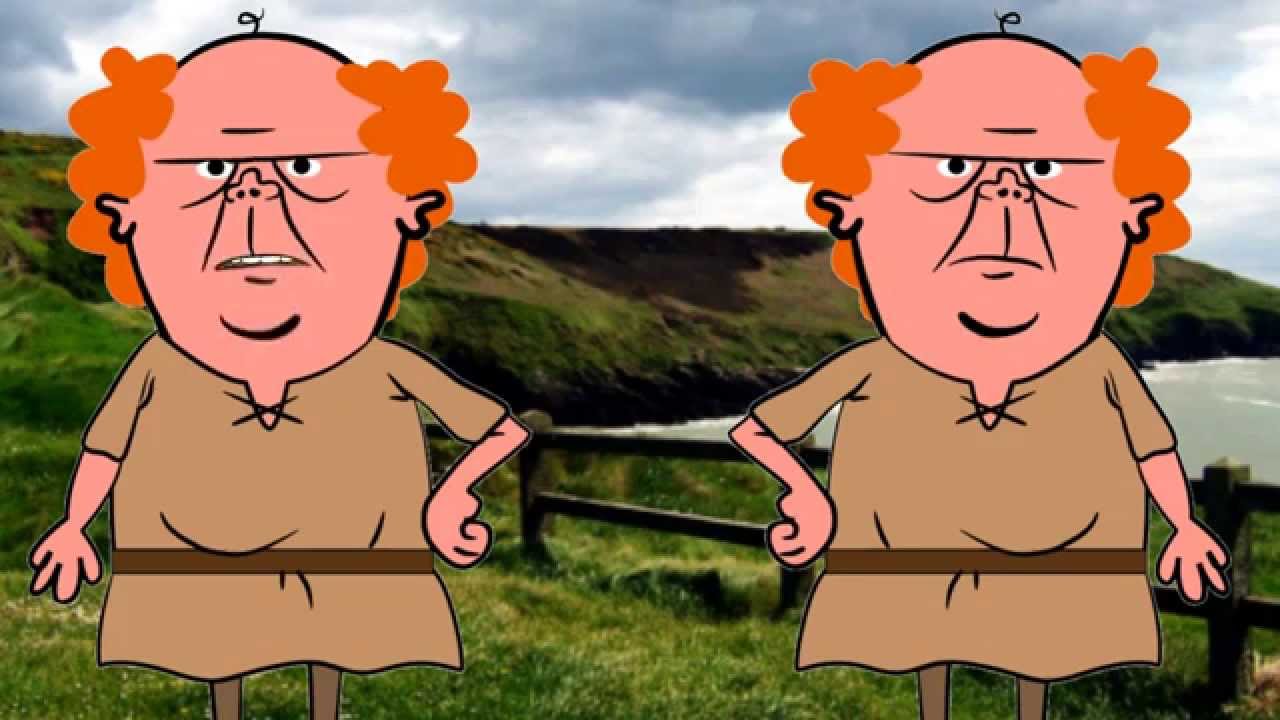
Donall and Conall Meet Richard Dawkins
There's no evidence of God's existence if you don't count all the evidence of God's existence. Donall and Conall are having a hard time understanding this, so Richard Dawkins has stopped by to enlighten them.
LutheranSatireI did write up another lengthy follow up comment on this matter but, whether by my blunder or clandestine interference, it has vanished.
I'm reluctant to try to reproduce what I said because I doubt that anyone at all is interested in anything that is not convenient to the fashionable Zeitgeist unless it can be contorted to a ridicule.
If anyone is interested just drop a comment here and I'll do my best.
I am genuinely interested, though the part which is of most interest to me is why the visual representation we imagine in our minds matters so much to some. Why must the visual be of a homo-sapien type figure?
Orrite, Leni, I'll take your word for it. I'm not going to try to re-present what I lost but I'll just start here and come back if necessary.
Your above question has to do with what and how we can "know" anything. In classical philosophy there's a flash term for it but it's no blardy use to us here.
To know is irrevocably linked to the ability to "conceptualise" universals and particulars... almost always some combination of visual and linguistic portrayals acquired. For example; a cat is a "universal" or type of animal that has some features common to cats. "My cat" on the other hand, has features that are common to all cats but it has peculiarities (features) that distinguish it from all the other cats. It's features are either innate or acquired... a cat cannot create itself.
Neither can a Man create himself. Nor can he ordain his origin and purpose or lack thereof.
Now we come to that singular commonsense principle that I have plugged relentlessly but which is universally ignored by contemporary narcissism: "a thing that does not exist cannot cause itself to exist".
I will assume that we agree that a Man has life, intellect and will (there are galahs "out there" who gratuitously assert that we have none of that individually) and I contend that those metaphysical "things" cannot create themselves but must be "gifted" from an antecedent source of abundance.
Again assuming that you accept the principle that anything cannot produce itself out of nothing let's get around to the anthropomorphic depictions of the ultimate source of Life, Intellect and Will that must come from something because they can't create themselves out of Nothing.
Because we have these metaphysical "things" built in it's pretty inevitable that we conceptualise the source of these "things" as something like us whereas the reasonable conception would be that we are a little bit like the Source just as a photograph is an "image" of the subject.
I can only guess about your underlying ideology but if you rally your mates and their apologetic I might guess more appropriately.
I’m not sure if this is going to lead to a whole other side but I feel it’s an important part in the equation.
What is man?
Man as you say is a being with life and intellect and will. But man is also a multi-trillion cellular organism, working in co-operative harmony
with various cellular departments which complete varying tasks. Eg. Your digestive cells aren’t involved in breathing, your breathing cells aren’t involved reproduction, etc.
Dogs are multi cellular organisms. As are trees and as are whales, etc.
So if God created man (a multi-trillion cell organism) in his image, isn’t it fair to say he created all other multi-called organism living creatures is his image also?
Show 6 more replies
Yair, well...
Let's take a very pragmatic and pedestrian look around this cellular organism thing. I will assume that you can acknowledge that there is a fundamental difference between a live organism and a dead one that is quite independent of its size or complexity. A dead blue whale is just as dead as a dead man or a dead bacterium.
Those of us who are not ideologically committed to magic materialism can make a pretty simple observation: in a freshly dead organism all the chemistry and structure are still present but it's not working! some immaterial "thing" or "stuff" that made it work has gone!
For brevity sake let's call that metaphysical "stuff" "life". Untold millions of observers have known intuitively and with certainty that all life is handed on from pre-existing, fundamentally, or essentially similar live beings. Live beings do not spontaneously "pop out of" a "warm pond" struck by lightening or anything else. Not even the most cunning manipulation of complex chemicals and technology in the most sophisticated laboratory can make a living cell.
Take note: we are saying that life does not spontaneously erupt out of jiggling atoms! we are saying that life is a necessary non-material addition that orders jiggling atoms into a live material being. If we can accept the obvious premise that "a thing (in this case life) that does not exist cannot cause itself to exist" we are left with (even if you claim an infinite regression of causes) an ultimate perfect source.
[quote=Leni] So if God created man (a multi-trillion cell organism) in his image, isn’t it fair to say he created all other multi-called organism living creatures is his image also? [/quote]
Phew! Navel gazing (a very diplomatic euphemism for what I really mean) is not a useful vantage for coming to a knowledge and understanding of reality. The "image and likeness" thing is not material or physical; it's a potential sharing of His eternal Life, Intellect and Will. Plants and animals are most certainly gifted with "life" but it's transient.
Yair, I think I can guess your next "objection" but I'll wait and see.
I don’t think I have another objection.
I was chatting to a man yesterday who decided he was done with all the lies of life and wanted to learn about living with nature. He hunts for food. He creates fires, he carves his own tools, builds shelters, makes rope, makes whistles, etc.
Maybe a little off topic but what’s your take on when a young child asked him how old he is. His response was “the same age as you, as old as the universe”.
I hope that child screwed up its face and shook its head thinking am I supposed to be able to learn anything from fwarknidiots. Did that clot try to explain how the "lies of life" are "done with" by a complete detachment from a realistic appreciation of the sequence of events that we call time?
St'rooth! There's really only one way to pretend you're smarter than God; repudiate reality and live in a fantasy.
Dump that eejut in the bush far from the "lies of life" and any children.
Hold on, are you saying a man who can build his own shelter (the natural way), gather his own food (the natural way), make his own tools (the natural way), create fire by gathering the right natural material and rubbing sticks together to create friction, etc is in some way going against God but we, who use gas heaters and buy groceries at the supermarket are more in touch with God?
Ah! Leni! I did notice this about a month ago and I did intend to reply but the intention got lost in a turmoil of other things that claimed my attention.
I think I am well qualified to criticise you and your guru as I (we) built our home out of stones and mud and discarded materials. I must admit, though, that I bought new cement and reo to hand make the bit of concrete used and I bought new iron and screws for the roof. Just about everything else was "junk". Right from when I was a very young man I determined that, with a bit of application, one can live very well on what the grandiose chuck away, and I had the notion that one shouldn't buy what we can make ourselves.
Being "more in touch with God" has practically nothing to do with physical skills, or academic prowess, or professional, social, wealth status... it is entirely dependent on how one comprehends and responds to the nature and purpose of human life and society.
In all of my years I have never seen a "back-to-nature", "age-of-Aquarius", hippy that was not a seething misanthrope lurking behind a mask of "luvvy-duvvy" emptiness. They effectively despise reality by proposing absolute nonsense; the more rationally nonsensical it is the more we're supposed to acclaim it as being "deep and meaningful".
Perhaps you should confront your guru with "Real Philosophy Is Science" but keep the galah away from impressionable, confoundable, children. Children normally have an intuitive appreciation of reality until it is "educated" out of them.
This guy is far from being a hippy (based on my understanding of the label hippy).
What I see is a man doing good, taking himself out of mans fictitious domain, a domain in which man believes he can improve on Gods already perfect land/habitat. He instead chooses to live by laws of nature, at least to a greater degree than what above 99% of men and women do. But then because of one statement this man made, a quick cast of judgement was placed upon him, not by God but by another man... Or am I barking up the wrong tree with this one?