
The grim reaper calls - Australians are dying like never before

An article by Dana Daniel, published in the Sydney Morning Herald on 21 September, has the title, "COVID complications push Australian deaths to highest numbers in 40 years". The article makes a number of absurd, unsupported speculations as to the cause of this sudden increase in mortality, the first one being the title of the article itself.
Daniel provides zero evidence that this shocking increase in mortality is due to COVID. Indeed, she provides evidence to the contrary, which she fails to acknowledge. Let me explain.
In the March quarter of 2022, there were 46,200 deaths from all causes in Australia. In the same period of the previous year 36,100 people died. That's an 18% increase in just one year.
As you can see from the data below, provided by the Australian Bureau of Statistics, deaths during the first year of the "deadly pandemic" were LOWER than average.

So let's just make this painfully clear. In the 3rd year after the onset of the pandemic, when practically every human has been vaccinated, either voluntarily or by coercion and threats, deaths are UP, but during the acute phase of the pandemic when there was no immunity at all and the virus variant was by all acounts more potent than today, deaths were DOWN.
Let that sink in for a moment.
The facts are clear, but Daniel takes the facts and twists them around to support a preposterous claim that the increase in deaths was due to the now dominant, mild "omicron" variant of COVID-19 or the vague and ill-defined "long covid" which she suggests is killing people at a greater rate than the acute infection.
NONE OF THIS ADDS UP
The glaringly obvious, monstrous FACT which she skirts around is that more people are dying AFTER the pandemic than DURING it.
The pandemic was supposedly a terrible crisis for which we shut down society for 2 years. The aim, supposedly, of these lockdowns, was to PREVENT DEATH.
During the first year of the pandemic, when there were no vaccines, the overall death rate in Australia was BELOW AVERAGE.
Now that the pandemic is over and life is supposedly "back to normal", people are dying at a greater rate than ever before in history. This dramatic increase in deaths started well AFTER purportedly "life saving" vaccines were introduced.
Those that support the government response to the pandemic and still believe in the vaccine are doing wild pirouettes in their attempt to rationalise the sudden uptick in DEATH after vaccination rates approached 90%. Check out this article from 11 September:
‘Terrifying’: Three-quarters of COVID deaths in aged care have occurred in 2022
In this article, the author, Anthony Galloway, makes 2 apparently contradictory statements.
Firstly he highlights the shocking fact that deaths from COVID in aged care have increased by 36% since May 2022.
An analysis of federal health data shows that while COVID-related deaths in aged care began to soar with the arrival of Omicron and the removal of restrictions within the community, they have increased by 36 per cent since the election of the Albanese government in May.
Then he makes an outrageous statement:
However, as the overall number of COVID-related deaths in aged care has increased, the death rate for people in nursing homes infected with COVID-19 has dropped dramatically – from 33 per cent in 2020 to 3.5 per cent in 2022.
If you're having trouble understanding the above, you're not alone. It sounds like he's trying to say that, while "covid-related deaths" have increased, "covid deaths" have decreased. The correct response to this is "huh?". My brain hurts. I don't know what "covid related deaths" means, and I don't really know what "covid deaths" means either. Do these words mean anything, or are we just playing word games with alphabet soup?
This graph illustrates in shocking brevity the scale of death taking place in aged care facilities RIGHT NOW.
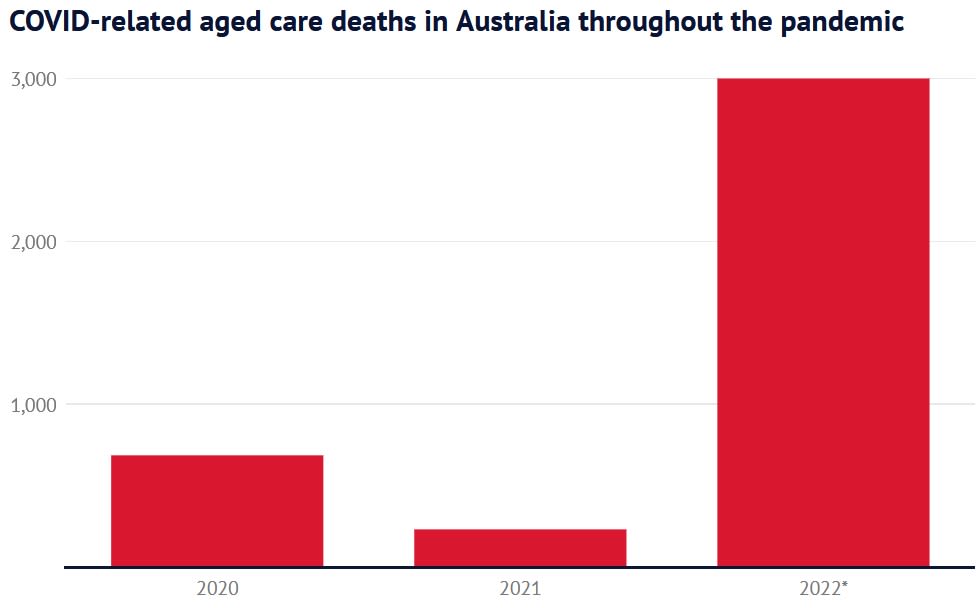
We know that 100% of aged care patients are vaccinated. How could anybody look at the above graph and then claim that "Due to continued access to antiviral treatments and vaccination, as well as greater preparedness in the sector, we have seen a dramatic reduction in the case fatality rate"? Yet that is EXACTLY what Aged Care Minister Anika Wells said.
The above graph should be on the front page of every newspaper. DEATHS IN AGED CARE AT 3X PANDEMIC LEVELS!. This simple, factual data shows, at best, that the reponse to the pandemic failed. At worst, it suggests that some aspect of the response is now killing people at a greater rate than the pandemic itself.
I've been trying to work out whether the authors of these preposterous articles are plain stupid, or deliberately trying to hide the obvious and deflect our attention from disturbing information using mental gymnastics and circular logic.
I have not reached a conclusion.
Full articles follow.
By Dana Daniel
Updated September 21, 2022
The alarm has been sounded about COVID-19’s hidden impact as new data shows that the highest number of people have died in the March quarter of 2022 than in any of the past 41 years.
Australian Bureau of Statistics population data published on Wednesday shows an 18 per cent increase in deaths in the quarter compared with the same period a year earlier, rising from 36,100 to 46,200 deaths.
It is the first time that more than 40,000 deaths were recorded over four consecutive quarters.
South-western Sydney Labor MP Dr Mike Freelander, Chair of the Senate inquiry into long COVID, said he was “very concerned” about higher-than-normal deaths in the pandemic and that more research was needed to ascertain why.
While the inquiry was focused on long COVID, he said, “there is a concern that COVID itself increases inflammatory responses, predisposes people to stroke and cardiovascular disease”.
“The other question is: are there risk factors, is there anything that can be done to modify the risk?” Freelander said.
The inquiry will collate data from scientific experts to gain insights into how COVID-19 affects health after the initial infection.
Karen Cutter, spokeswoman for the Actuaries Institute COVID-19 Mortality Working Group, said about 6000 more people died in the March quarter than could be explained by the ageing population.
Half of these people died from COVID-19, she said, with a further 500 dying “with COVID”, their deaths from causes such as cancer, circulatory diseases and dementia likely to have been hastened by the pandemic.
The remaining 2500 people died from other causes. While it is unclear what, if any role COVID-19 may have played, a higher-than-usual number of deaths from strokes, heart disease, dementia and diabetes makes the working group suspect that it could be a factor.
“There are people who have had COVID and recovered, but it may have weakened their immune system [and] they’ve subsequently had a heart attack or stroke that might not necessarily be directly linked back to their COVID episode,” Cutter said.
“Studies show that having COVID increases your risk of these sorts of things.”
Another possible reason for the increase in deaths this year, she said, was that vulnerable people who were shielded from influenza in the winters of 2020 and 2021 due to COVID-19 restrictions have since succumbed to other causes of death.
“There will have been some delayed deaths from those earlier years,” she said.
Undiagnosed COVID-19 was not expected to be a major contributor as people suspected to have died from the virus were being tested after death.
Assistant Health Minister Ged Kearney on Wednesday announced $6.3 million in funding for research led by Monash University to evaluate the immune response in children and high-risk populations, including adults with chronic conditions, to COVID-19.
The project aims to improve the care and outcomes for children and people with chronic diseases, including tailored treatments and vaccination schedules appropriate to children and high-risk groups.
Adults with chronic kidney and lung disease, Inflammatory Bowel Disease, rheumatic diseases, people living with HIV and organ transplant recipients will be among the patients to be studied.
By Anthony Galloway
September 11, 2022 — 5.00am
More than 3000 Australians have died with COVID-19 in aged care facilities this year, triple the number of deaths in nursing homes during the first two years of the pandemic.
An analysis of federal health data shows that while COVID-related deaths in aged care began to soar with the arrival of Omicron and the removal of restrictions within the community, they have increased by 36 per cent since the election of the Albanese government in May.
However, as the overall number of COVID-related deaths in aged care has increased, the death rate for people in nursing homes infected with COVID-19 has dropped dramatically – from 33 per cent in 2020 to 3.5 per cent in 2022.
Labor introduced a “winter plan” to help deal with the escalating wave of cases in the community, and last week passed a bill in parliament to overhaul the sector which includes a mandate for aged care homes to have 24/7 nurses. But there is growing concern that the thousands of deaths in aged care this year are not being sufficiently scrutinised.
Independent MP Rebekha Sharkie said the nation was struggling from “COVID fatigue” and suggested the media and politicians were no longer holding the government to account.
“In 2020, this would have been on the front page every day. It also would have been a question in question time every day,” said Sharkie, whose regional electorate of Mayo has the oldest age demographic in South Australia.
“So I think we all have a role to play in making sure that we’re all accountable for this.
“Those statistics that you quoted to me are terrifying. And I think if I had a parent or grandparent in aged care, I’d be very worried.”
Sharkie noted that in 2020 and 2021 the then-aged care minister Richard Colbeck was asked a question most days in federal parliament about how many people had died, but now there was a lack of scrutiny.
“I think there’s probably an element of COVID fatigue in the media and perhaps in the parliament,” she said.
“It’s almost like there’s a political will for COVID to go away, and it hasn’t gone away. So we’re just not going to really talk about it anymore.”
An average of 102 people with COVID-19 are dying every week since election day, compared to a weekly average of 75 under the Coalition for the first five months of this year, or nine during 2020 and 2021.
More COVID-related deaths in aged care facilities have occurred under Labor in its first three months of government (1431) than under the Coalition over the first two years of the pandemic (917).
There were 1498 reported deaths under the Coalition up to May 19 this year.
However, the death rate from COVID in aged care has gone down. In 2020, more than 33 per cent of COVID cases in residents resulted in deaths, but this has dropped to 3.5 per cent in 2022.
In July this year, there were at times more than 10,000 people infected with the virus in aged care facilities. This compared to just 21 cases at the same time last year.
Paul Sadler, the interim chief executive of the Aged and Community Care Providers Association, said his organisation was concerned about the increase in COVID-19 deaths. But he said it was important to note that the number of COVID cases and outbreaks in aged care facilities has been falling in recent weeks along with the reduction in COVID-19 cases in the community.
“With COVID in the community Australia-wide, the increase in infections during the first Omicron wave in December 2021 to February 2022, and then the latest wave in winter sadly proved to be deadly to many vulnerable older Australians in care,” he said.
Sadler said aged care providers were remaining vigilant by maintaining infection protocols and urging residents, visitors, clients, and staff to keep up to date with vaccinations.
Opposition aged care spokeswoman Anne Ruston accused Labor of being “hypocritical”, saying in opposition it was highly critical of the way the Coalition had handled the pandemic but it was doing worse in government.
“They are tracking in exactly the opposite direction from everything that they said they were going to do and everything they criticised us for not doing,” she said.
“Have they done everything they possibly could do to try and reduce the impact of COVID in aged care homes? Or are they more focused on ticking and flicking election commitments that don’t have any impact for many, many months?”
Aged Care Minister Anika Wells said every death in Australia due to COVID-19, including those in aged care, was a “tragedy”.
She said one of the first acts of the Albanese government was to put in place its winter plan.
“Due to continued access to antiviral treatments and vaccination, as well as greater preparedness in the sector, we have seen a dramatic reduction in the case fatality rate,” she said.
“We’ve left no stone unturned in managing the response to COVID-19 in aged care.
“We have extended the ADF’s role in aged care until the end of September and have a surge workforce that provided 1704 shifts last week.”